IQ Test Format: Structure, Question Types and Timing

An IQ test is a standardized set of tasks, usually grouped into verbal, reasoning, visual-spatial, working-memory and speed sections, that is scored against a norm group so the result can be expressed on a scale with a mean of 100. The format varies by who gives it. A clinician-administered battery is one-on-one and takes roughly 45 to 60 minutes. An online test is typically a single sitting of multiple-choice items answered on a screen. This guide explains both formats, the question types in each, and how raw answers become a score.
TL;DR
- Professional IQ tests (such as the Wechsler adult scale) are given individually by a trained examiner, in about 45 to 60 minutes for the core subtests.
- Online IQ tests are usually fixed-length, multiple-choice and self-administered. Ours has 50 questions across five cognitive domains.
- Question types fall into a few families: verbal, numerical, logical or matrix reasoning, visual-spatial, and memory or speed tasks.
- Raw scores are converted to a scale with a mean of 100 and a standard deviation of 15, so format matters less than whether the test was normed on a representative sample.
- A short online format can show a broad range. It cannot replace a clinical evaluation.
Table of Contents
- What an IQ test is made of
- The format of a professionally administered test
- The format of an online IQ test
- IQ test question types
- Timing: untimed, timed and adaptive
- How answers become an IQ score
- Perspective: what format tells you about a test’s quality
- Choosing the right format for your goal
- Take our 50-question IQ assessment
- Practical tips before you sit any IQ test
- FAQ
- Sources
What an IQ test is made of
Every credible IQ test has the same skeleton, whatever its length:
- A set of items that sample different cognitive abilities.
- Standard administration: the same instructions, the same time rules and the same scoring for every test-taker. OpenStax defines standardization as keeping administration, scoring and interpretation consistent across participants.
- A norm group: raw performance is compared with a reference sample, and the comparison produces the score.
- A composite score and, usually, scores for narrower abilities.
The items themselves differ in content. WebMD notes that IQ tests measure crystallized intelligence (accumulated knowledge) and fluid intelligence (logic and reasoning), and that many tests measure both. Vocabulary and general-information questions lean on the first. Matrix and pattern questions lean on the second.
The format of a professionally administered test
The best-known adult battery in the United States is the Wechsler Adult Intelligence Scale, Fifth Edition (WAIS-5), published by Pearson in 2024. Pearson’s comparison flyer states that the 7-subtest Full Scale IQ takes approximately 45 minutes to administer, and the 10 primary index subtests take about 60 minutes.
Several features define this format:
- One examiner, one test-taker. The examiner reads instructions, presents materials, times responses and records answers. Many tasks are oral or use physical or on-screen stimuli rather than a multiple-choice grid.
- Subtests grouped into indexes. Children’s batteries show the same logic: the WISC-V has 14 subtests comprising five indices, and the test-taker receives a score for each index plus a Full Scale IQ.
- Variable duration. According to the Pearson technical and interpretive manual, administration time depends on which subtests the practitioner chooses, and secondary subtests lengthen the session. The same documentation describes special start points for examinees suspected of intellectual giftedness, which cut testing time by about 25% compared with standard start points.
- Discontinue rules. On many subtests items get harder, and the examiner stops after a set number of consecutive misses. This keeps the session from becoming a string of failed items.
The design also changes over editions. The same manual reports that the WAIS-5 removed Picture Completion to lower the emphasis on speed, and replaced Cancellation with a motor-free Naming Speed Quantity task. Test makers revise formats to reduce the influence of things unrelated to reasoning, such as fine motor control.
For a deeper look at duration across test types, see our guide to how long an IQ test takes.
The format of an online IQ test
Online tests trade the examiner for software. That produces a recognizable format:
- Fixed number of items, commonly 20 to 50, presented one at a time.
- Multiple-choice answers. Free response and oral tasks are hard to score automatically, so they are rare online.
- Self-paced or loosely timed sessions, sometimes with an overall limit.
- Mixed item types to approximate a spread of abilities in a short sitting.
- Instant scoring against a stored norm table.
Our own assessment follows this pattern. It has 50 questions across five cognitive domains, and you can complete it without creating an account. You first see a broad result category. You can then optionally unlock your exact IQ score, percentile context, five-domain breakdown, personalized report, verifiable certificate and Career Matches for a one-time $9.99 per completed result. It is not a subscription.
How the two formats compare
| Feature | Clinician-administered (e.g., WAIS-5) | Online self-administered test |
|---|---|---|
| Who gives it | Trained examiner | The test-taker, alone |
| Typical duration | About 45 to 60 minutes for core subtests (Pearson, 2024) | Varies by test; often a single short sitting |
| Answer style | Oral, manipulative and on-screen tasks | Mostly multiple choice |
| Environment control | Examiner controls setting and pacing | Depends on the test-taker |
| Output | Full Scale IQ plus index scores, interpreted by a professional | Score or category, plus whatever report the site provides |
| Best use | Clinical, educational and legal decisions | Self-insight, curiosity, career exploration |
The key difference is control. An examiner can notice that you were distracted, ill or anxious and note it. A website cannot. For this reason an online result is best read as an informed estimate, and a professional score is the one institutions accept.
IQ test question types
Question names differ between tests, but nearly all items fall into five families.
Verbal reasoning
These items test word knowledge and verbal logic. Common forms include:
- Vocabulary: define a word or pick its synonym or antonym.
- Similarities: say how two things are alike, or choose the word that does not belong.
- Analogies: “hand is to glove as foot is to ___.”
- General information: factual questions drawn from common knowledge.
These lean on crystallized intelligence, and they are the items most affected by education and language background.
Numerical reasoning
Numerical items check quantitative thinking, not advanced mathematics.
- Number series: find the rule and give the next number (for example, 2, 6, 18, 54, ?).
- Arithmetic word problems: short mental calculations, which on Wechsler tests are done without paper.
- Quantitative comparison: which of two expressions is larger, or what value balances an equation.
The Wechsler scales include a visual version of quantitative reasoning, in which the examinee looks at balance scales with a missing weight and selects the answer that keeps them level.
Logical and matrix reasoning
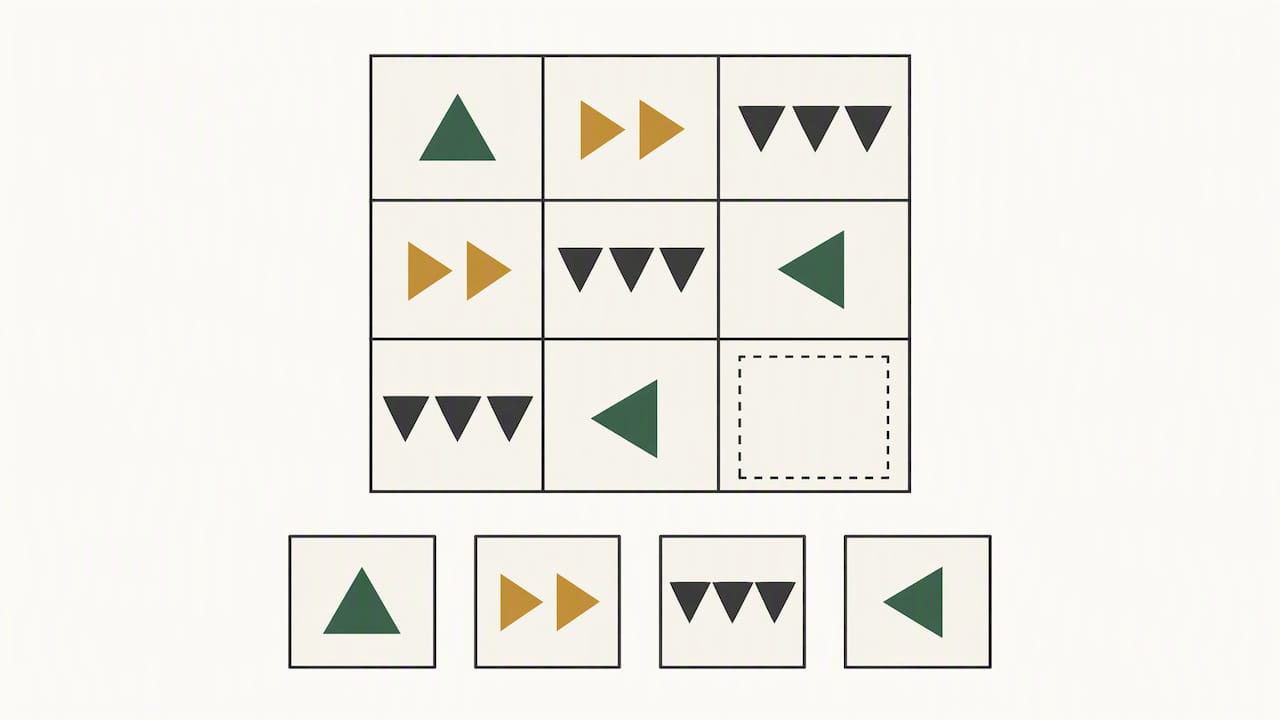
This is the classic fluid-reasoning format. You see a grid or sequence of shapes with one cell missing and choose the option that completes the pattern. Related items include syllogisms (“All A are B; some B are C; what follows?”) and rule-discovery puzzles. They need no specialized knowledge, which is why they are used to approximate reasoning that is less dependent on schooling. If you plan to prepare for pattern items before a hiring assessment, our guide to inductive reasoning practice covers a four-week routine.
Visual-spatial tasks
These ask you to mentally manipulate shapes.
- Block design: reproduce a pattern with blocks (physical on clinical tests).
- Visual puzzles: pick the pieces that would assemble into a target shape.
- Cube and rotation items: decide which rotated figure matches a reference, or count faces of a folded cube.
Working memory and processing speed
Clinical batteries include short-term memory and speed tasks that online tests often skip or approximate.
- Digit span: repeat a series of digits forward, backward, or in ascending order.
- Symbol coding or search: match symbols to a key against the clock.
- Detail checking: spot a mismatch between two strings quickly.
Speed tasks are controversial. As noted above, the latest Wechsler edition reduced emphasis on speed, and some tasks moved to motor-free versions.
Timing: untimed, timed and adaptive
There are three common timing designs.
- Untimed or generously timed. The score reflects accuracy. Many clinical reasoning subtests work this way, with bonus points for speed on only a few.
- Strict overall limit. A fixed window for the whole test, common in pre-employment assessments. Time pressure becomes part of what is measured.
- Adaptive. The next question depends on your previous answers, so the test needs fewer items to locate your level.
If a test’s time limit is tight, then speed and accuracy are mixed in the result. Check the instructions before you start, and do the test in one sitting without interruptions. Our article on IQ test length by type compares the options.
How answers become an IQ score
The conversion has three steps.
- Raw score. Count correct answers, or the points awarded per item on subtests with partial credit.
- Scaled or standardized score. The raw score is compared with people in the same age band from the norm sample. This is why a score is relative, not absolute.
- Composite IQ. Subtest or domain scores are combined into an overall figure. The Pearson manual says the Full Scale IQ is generally the first choice for ability-achievement discrepancy analysis because it provides the broadest sample of behavior, although other scores can be appropriate in some circumstances.
Modern IQ scores are defined with a mean of 100 and a standard deviation of 15. OpenStax explains that this means about 68% of the population scores between 85 and 115. You can explore that distribution with our IQ standard deviation calculator and convert a score to a rank with the IQ percentile calculator.
One number, or several
Most contemporary tests, including the Wechsler and Stanford-Binet batteries, give a single overall IQ and also report scores for specific abilities, reflecting both general intelligence (“g”) and narrower cognitive factors, according to a SAGE text. That is why a five-domain breakdown is more informative than a single figure: two people with the same overall score can have very different profiles.
Why scales differ between tests
Some tests use a standard deviation of 15, others use different scales, and some older or high-range tests use a different spread. The same person can therefore receive numerically different results from different tests. Use the IQ score converter to compare scales, and read what your IQ number means before drawing conclusions.
Norm age matters too. The American Psychological Association notes the Flynn effect complicates comparisons over time, since earlier standardized tests tend to yield higher scores than later versions. A test with outdated norms tends to overstate results, so the date of standardization is worth checking.
Perspective: what format tells you about a test’s quality
We read test formats as evidence about method. Our view, drawn from how we build our own assessment, has four parts.
First, length is a trade-off, not a quality mark. A 50-question test samples fewer behaviors than a 45-to-60-minute clinical battery, so it supports a narrower claim: a broad estimate and a domain profile, not a diagnostic conclusion. That is why we show a broad result category first and keep the exact score as an optional unlock.
Second, consistency matters more than novelty. The same logic that makes clinical tests credible, identical procedures and updated norms, is the standard we hold an online test to. The same principle applies to other self-screening formats, such as dyscalculia screening tools, where a structured, repeatable procedure is what makes results interpretable.
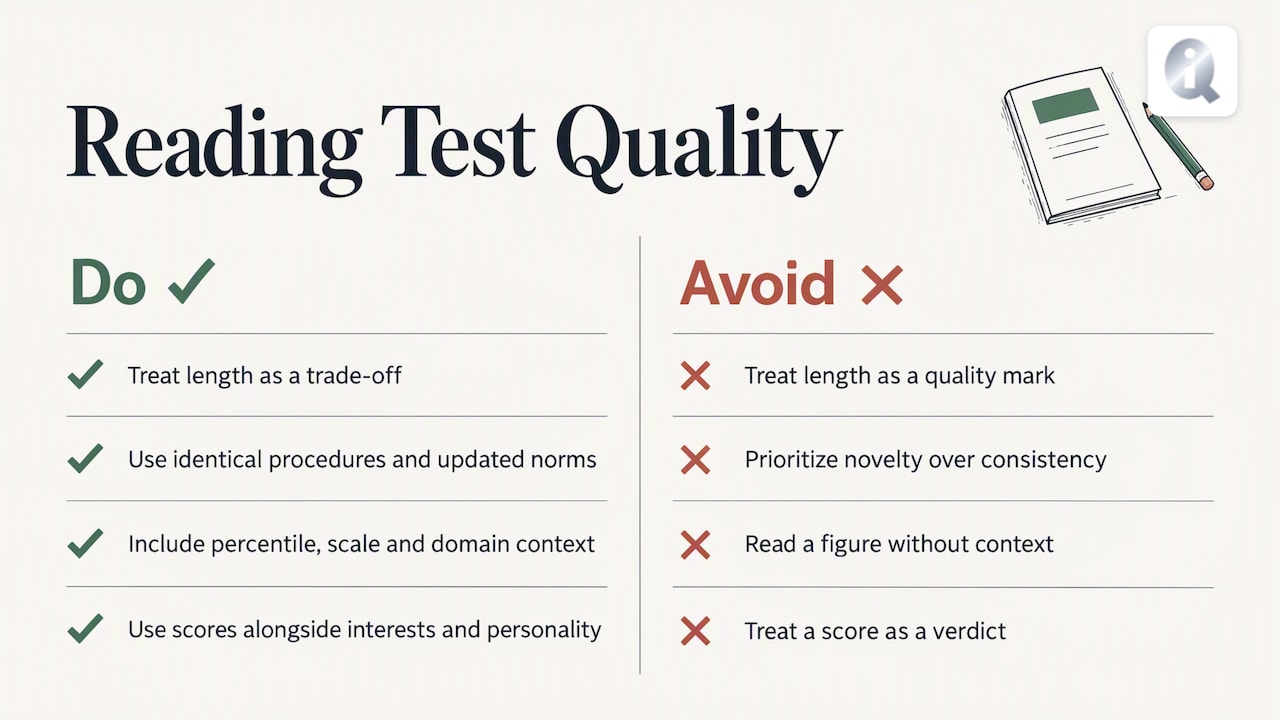
Third, the score is only as useful as its context. A figure without a percentile, a scale and a domain breakdown invites misreading. Our paid result includes percentile context and a five-domain view for that reason.
Fourth, no format settles a person’s potential. A cognitive score describes performance on a set of tasks at one time. It is a useful input to career exploration alongside interests and personality, and not a verdict.
— Steve
Choosing the right format for your goal
| Your goal | Format that fits |
|---|---|
| Curiosity or self-insight | A free online test with a clear explanation of scoring |
| Seeing your cognitive profile by domain | An online test that reports domain-level scores |
| Career exploration | A profile-based result that connects strengths to job options |
| School placement, accommodations, or clinical questions | A clinician-administered battery |
| Practicing for an employer’s aptitude screen | Timed practice with the same item types |
If you are unsure which applies, start with the shorter, lower-stakes format and escalate only when a decision depends on the result.
Take our 50-question IQ assessment
Our assessment uses the format described above: 50 questions across five cognitive domains, no account required. You get a broad result category immediately. If you want the detail, the one-time $9.99 unlock adds your exact IQ score, percentile context, five-domain breakdown, a personalized report, a verifiable certificate and Career Matches. There is no subscription, and the price applies once per completed result. See the Full IQ Result on our pricing page, or browse the free IQ tools first.
If you also want to understand your work style, the separate Big Five personality assessment requires sign-in and gives OCEAN trait percentiles and an archetype for free.
Practical tips before you sit any IQ test
- Read the instructions fully. Check the time limit and whether wrong answers are penalized.
- Take it in one sitting in a quiet place. Interruptions lower scores for reasons unrelated to ability.
- Skip and return. On timed tests, a hard item can cost time better spent on easier ones.
- Do not over-practice a single item type if you want an honest estimate. Practice is appropriate when you are preparing for an employer’s test.
- Interpret the result in context. Compare with the norm, not with a friend’s number from a different test. Our guide to a good IQ score and the article on the US average IQ explain what 100 does and does not represent.
FAQ
What is on an IQ test?
Most IQ tests combine verbal items (vocabulary, similarities), numerical items (number series), logical or matrix reasoning, and visual-spatial puzzles. Clinical batteries add working-memory and processing-speed tasks. The exact mix depends on the test and its edition.
How many questions are on an IQ test?
It depends on the format. Online tests commonly use a fixed set of multiple-choice items, and ours has 50 questions. Professional batteries are organized by subtests, with the WAIS-5 Full Scale IQ drawing on 7 subtests and the primary index score on 10, according to Pearson’s 2024 materials.
How long does an IQ test take?
Pearson states that the WAIS-5 takes about 45 minutes for the 7-subtest Full Scale IQ and about 60 minutes for the 10 primary index subtests. Online tests vary by design, and some have an overall time limit. Our IQ test length guide compares the types.
Are online IQ tests the same as professional ones?
No. Professional tests are individually administered under controlled conditions and interpreted by a trained examiner. Online tests are self-administered and mostly multiple choice, so they suit self-insight and career exploration, but not clinical or legal decisions.
Can I see how my score compares with others?
Yes. Scores are expressed against a norm with a mean of 100 and a standard deviation of 15. Use the IQ comparison tool to see how scores relate to jobs, countries and well-known figures.
Sources
- WAIS-5 Comparison Flyer, Pearson (2024)
- WAIS-5 Q-Global Technical and Interpretive Manual, Pearson (2024)
- Measures of Intelligence, Psychology, OpenStax
- Chapter 7 Key Terms, Psychology 2e, OpenStax
- IQ Tests: History, Methodology, and Accuracy, WebMD
- Smarter than ever?, American Psychological Association (2013)
- Intelligence chapter, SAGE Publications