Inductive Reasoning IQ: Four Weeks of Practice for Job Applicants

Inductive reasoning is the skill of inferring a general rule from specific examples, and it is a core part of the fluid reasoning that IQ tests try to capture. Targeted practice reliably raises scores on these items, and controlled training studies report moderate transfer to broader reasoning measures. What practice cannot promise is a large, lasting change in your underlying ability.
TL;DR:
- Effective practice mixes item types, spaces sessions, and reviews why distractors fail; occasional full timed tests build pacing across formats.
- A four week plan moves from untimed practice to mixed items and an error log, then timed sets, ending with a full test and review.
- Compare scores on similar tests before and after practice, but retake a formal assessment only after completing the four week plan.
Table of Contents
- What is inductive reasoning and how does it work?
- How does inductive reasoning connect to IQ and fluid intelligence?
- Which test formats show up most often?
- What do worked sample questions look like?
- What does the evidence say about training and practice effects?
- Who takes inductive reasoning tests, and how are results used?
- Where can you practice, and what does a simple four-week plan look like?
- Why we cover inductive reasoning
- Get domain feedback with our Full IQ Assessment
- FAQ
- Sources
What is inductive reasoning and how does it work?
Inductive reasoning moves from observations to a general conclusion, and that conclusion is probabilistic, not certain. You see three swans that are white and infer that swans are white, which a single black swan can overturn. Inductive reasoning is the opposite direction from deduction, which starts with a general rule and applies it to a specific case.
Everyday versions are easy to spot:
- Noticing that a bus has been late every Monday and predicting it will be late next Monday.
- Spotting that each number in a sequence is double the one before it.
- Seeing that “hand is to glove as foot is to sock” and carrying that relationship to a new pair.
- Sorting a group of shapes by a shared feature you had to discover yourself.
Test items are these same moves with the everyday context stripped away, so the rule is all you have to work with. The Cleveland Clinic describes the process as collecting experiences, forming a hypothesis, integrating new information, and confirming it.
How does inductive reasoning connect to IQ and fluid intelligence?
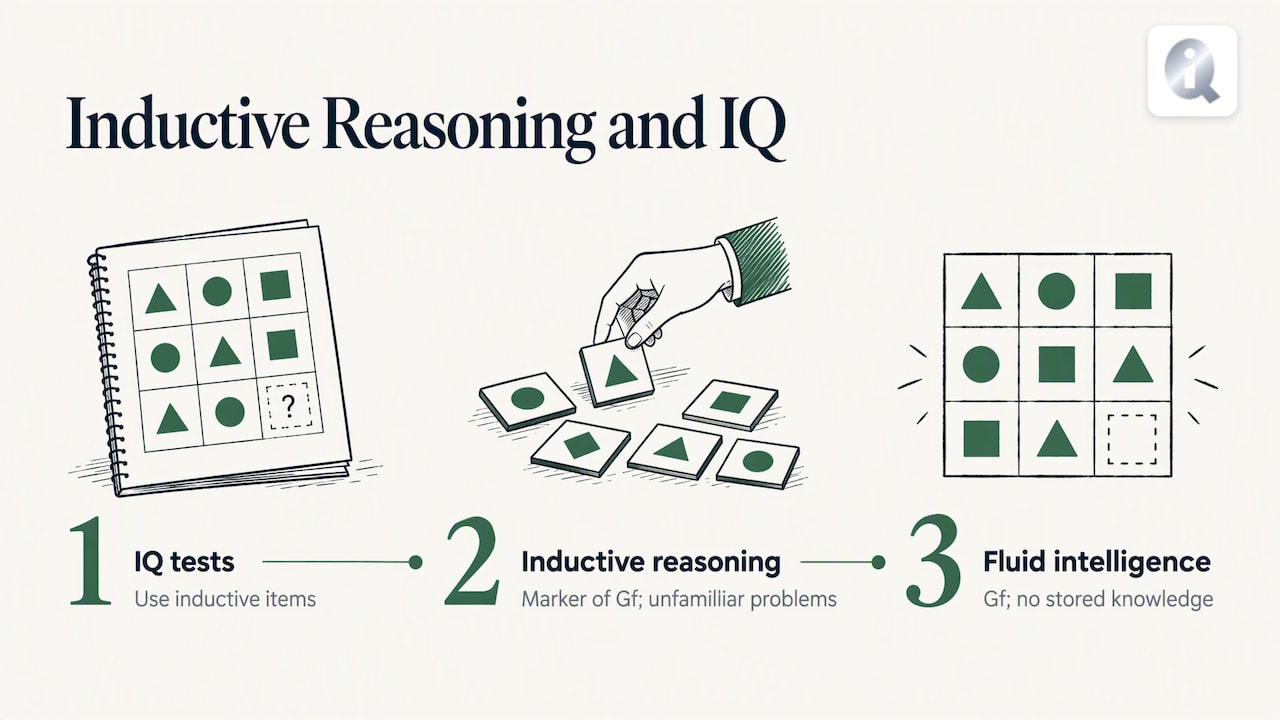
IQ tests use inductive items because they require solving a problem you have never seen, without relying on stored knowledge. That is the definition of fluid intelligence (Gf), and inductive reasoning is treated as a marker of it, as the Lumen Learning course text explains.
Cognitive abilities are also fairly stable. A meta-analysis in Psychological Bulletin of 205 longitudinal studies found high rank-order stability from late adolescence into adulthood, with general intelligence among the most stable abilities and stability falling as the gap between tests grows.
A meta-analysis of 205 longitudinal studies with 87,408 participants found that cognitive abilities keep a high rank-order stability from late adolescence into adulthood. Your relative standing tends to hold over time, which is why training results are judged against a stable baseline. (Psychological Bulletin)
Stable does not mean fixed. Experiments that train inductive reasoning directly report moderate effects, and we cover them below.
Which test formats show up most often?
Most inductive reasoning tests draw on a small set of item types, and each one isolates a slightly different operation:
- Figural matrices: a grid of shapes with one cell missing. You look for rules across rows and columns, such as shapes that rotate, add elements, or cancel each other out.
- Series and sequences: numbers, letters, or shapes in order. You identify the relationship between neighboring items, then apply it to find the next one.
- Analogies: a pair of items shares a relationship, and you must find the second pair that matches it.
- Classification: you decide which item does not belong by comparing attributes.
Aptitude sections are often timed, so spotting the rule quickly matters as much as spotting it at all. Timing and item counts differ by publisher, so check the format of the specific test you will take.
What do worked sample questions look like?
Here are two items with the reasoning laid out step by step.
Matrix item. A 3x3 grid shows a circle, a square, and a triangle in each row, in a different order every time. The bottom-right cell is blank.
- Scan rows first. Each row holds all three shapes once, so the rule is “each shape appears once per row.”
- Check columns. The same holds down each column, so the rule is consistent.
- Name the missing shape. The other rows use up the circle and the triangle in the last column, so the blank must be a square.
- Eliminate distractors. Any answer option showing a circle or triangle breaks the pattern and can go.
Sequence item. What comes next in a sequence where each term is three times the previous one?
- Test addition. The gaps are not constant.
- Test multiplication. Each term is three times the previous one.
- Apply the rule: 54 x 3 = 162.
The common traps are locking onto the first pattern you notice and ignoring a second rule running at the same time.
What does the evidence say about training and practice effects?
Practice raises scores, and researchers have to account for it. A longitudinal analysis found practice effects across all five neurocognitive abilities studied, including reasoning, though their size differed by age and ability type. A related study on age found practice estimates were often as large as the observed longitudinal changes.
The more interesting question is whether practice builds real skill. Training that has people compare similarities and differences between items, Klauer-style procedures, can change inductive reasoning and transfer to broader fluid intelligence measures, not just the practiced items.
A review of 74 experiments of inductive reasoning training reported a weighted mean effect of d+ = 0.52 on intelligence test performance. That is a moderate gain, and it extended to academic learning too.
A game-based program tested in 2022 reported a corrected effect size of .38 for improving inductive reasoning.
Routines that mirror this evidence:
- Mix item types instead of drilling one format.
- Space sessions over time, a method retrieval practice research supports.
- After each item, compare the right answer with the distractors and name the difference.
- Take an occasional full timed test to build pacing.
- Use adaptive or game-based drills when you want variety.
Set realistic expectations: organized practice should move your test scores. Large, lasting changes in trait-level ability are less certain and depend on how broad the training is and how long you keep it up.
Who takes inductive reasoning tests, and how are results used?
These tests appear mainly where an organization needs to compare people on how they handle unfamiliar problems. The Cleveland Clinic notes they turn up in both neuropsychological and employment aptitude settings.
- Recruitment screens: early filters for roles that involve analysis, troubleshooting, or learning new systems.
- Graduate selection: schemes that cannot assume candidates share the same subject background.
- Technical and operations roles: jobs where novel problems come up regularly.
Employers favor nonverbal items because they measure problem solving independent of prior domain knowledge. Results are usually read as a percentile, meaning where you stand relative to a comparison group, and some reports break scores into domains so you can see where to focus. Our IQ score converter helps you compare scales and percentiles.
Where can you practice, and what does a simple four-week plan look like?
Useful resources include timed mock tests, item banks, adaptive drills, and game-based modules. Our free tools page collects calculators and assessments you can use alongside them.
- Start: learn each format with untimed items.
- Next: mix formats and start your error log.
- Then: add timed sets and review your answers.
- Finish: take a full timed test, then review every miss.
Compare your scores on similar tests before and after the plan, and retake a formal assessment only after you have finished it.
Why we cover inductive reasoning
We build our workaround measurable cognitive domains, and inductive reasoning is one of the clearest examples of a skill you can both measure and practice. Our IQ assessment and the tools for reading a domain breakdown exist so you can see where you stand before and after practice. Use the two together: practice to build the skill, then an assessment to check what changed.
— Steve
Get domain feedback with our Full IQ Assessment
If you want to know how your reasoning compares before you invest hours in practice, our Full IQ Assessment gives you a domain breakdown and percentile context. Unlocking the full report on our pricing page costs $9.99 one-off, and it shows you which cognitive areas to prioritize. Start the assessment, see your result range, and decide whether the detailed report is worth it for your plan.
FAQ
Is logical reasoning part of IQ?
Yes. Logical and inductive reasoning items are standard components of many IQ tests because they probe fluid intelligence, the ability to solve unfamiliar problems. Most test batteries combine them with verbal, spatial, and memory tasks.
What is inductive reasoning in critical thinking?
It is drawing a general conclusion from specific observations, then judging how well the evidence supports it. Critical thinkers treat these conclusions as probable, not certain, and stay open to evidence that overturns them.
What are the main types of reasoning?
The two most common are inductive reasoning, which builds general rules from examples, and deductive reasoning, which applies a general rule to a specific case. Many lists add abductive reasoning (inferring the best explanation), analogical reasoning, and causal reasoning.
Can practice improve inductive reasoning scores?
Yes. Longitudinal research shows practice effects across reasoning and other abilities, and training studies report moderate gains. Lasting trait-level change is less certain.