IQ and Personality: What the Research Shows

IQ and personality are related, but only modestly, and they measure different things. An IQ test records your best performance on cognitive tasks. A personality assessment describes your typical patterns of thinking, feeling, and behaving. The most consistent finding is a positive link between Openness and cognitive ability, while the direction of links for Neuroticism, Conscientiousness, Agreeableness, and Extraversion depends on the sample and on the facet measured. No personality type has a reliably established “highest IQ.”
TL;DR
- IQ tests measure maximal performance; personality measures describe typical behavior, so the two are separate instruments.
- Openness is the trait most consistently tied to intelligence (a meta-analytic correlation of .26 with general mental ability).
- Neuroticism tends to relate negatively to cognitive ability, while Conscientiousness and Agreeableness show mixed results across studies.
- Facet-level measurement explains more than broad traits, so a single “personality type” says little about your IQ.
- Treat both scores as complementary inputs: cognitive ability describes capacity, personality describes style.
Table of Contents
- What Each Kind of Test Measures
- How the Two Are Correlated
- Why Findings Differ: Broad Traits Versus Facets
- Which Personality Type Has the Highest IQ?
- Does Personality Cause IQ, or the Reverse?
- Effort, Organization, and the Compensation Hypothesis
- Measuring Personality Beyond Self-Report
- What We Think: Reading Both Scores Together
- Take Both Assessments
- How to Interpret Your Two Results
- FAQ
- Sources
What Each Kind of Test Measures
The distinction starts with what is being asked of the test taker. Ability tests are maximal-performance measures: you are asked to do your best on items with right and wrong answers. Personality measures instead estimate average performance, and they typically rely on reports of preferences, of what a person normally does, and of how they perceive themselves and are perceived by others.
The definitions used in the literature reflect this. Intelligence is the ability to understand complex ideas, adapt to the environment, learn from experience, and reason. Personality is the set of individual differences in characteristic patterns of thinking, feeling, and behaving.
The boundary is not perfectly clean. The same review notes that intelligence tests and personality assessments are not entirely independent: motivation affects performance in low-stakes testing, and cognitive ability can influence how people respond to personality items. Any correlation between the two therefore reflects both the underlying constructs and the methods used to measure them.
| Feature | IQ assessment | Personality assessment (Big Five) |
|---|---|---|
| What it captures | Maximal performance on cognitive tasks | Typical thoughts, feelings, and behavior |
| Item format | Right and wrong answers | Self-report on preferences and habits |
| Output | Score, percentile, domain profile | Trait percentiles (O, C, E, A, N) |
| Main influence on a poor result | Ability, fatigue, test conditions | Self-perception, response style |
How the Two Are Correlated
Openness and intellect
Openness is the clearest link. A 2023 meta-analysis by Stanek and Ones found that global Openness correlates with general mental ability at .26, with stronger links to verbal abilities than to quantitative ones. A correlation of .26 is meaningful but modest: it means Openness explains a small share of the differences in cognitive ability, not most of them.
The broad trait is itself made of two parts. DeYoung and colleagues reported that the intellect aspect of Openness/Intellect is associated with general intelligence, whereas the openness aspect is specifically tied to verbal intelligence. In practical terms, curiosity about ideas (intellect) tracks general reasoning, while aesthetic and imaginative interests (openness) track vocabulary and verbal skill more narrowly.
If you want the creative side of this trait, our page on openness and creativity covers what the research says about it separately from intelligence.
Neuroticism
Neuroticism generally runs in the opposite direction. A large-sample study by Carretta and Ree, totaling 120,014 participants, found a positive relationship between cognitive ability and Openness and negative relationships with Neuroticism and Conscientiousness. The 2012 twin study from the Netherlands reported the same direction for Neuroticism, along with positive correlations for Openness and Agreeableness.
Two cautions apply. Anxiety can interfere with test performance, so part of this link may reflect testing conditions as well as ability. And the same studies show the correlations vary with the specific content of the cognitive and personality measures used.
Conscientiousness, Extraversion, and Agreeableness
These three traits are where studies disagree. In the Wisconsin Longitudinal Study, higher adolescent IQ was related to higher Openness and lower Neuroticism, Extraversion, Agreeableness, and Conscientiousness in adulthood. The twin study above found Agreeableness positively correlated with IQ. Both can be true: samples, ages, instruments, and the way each study defines the trait differ.
The 2023 meta-analysis adds that associations are not limited to Openness. Particular facets of Neuroticism, Extraversion, and Conscientiousness also relate to some abilities, and the size and direction depend on the specific facet and cognitive construct.
Why Findings Differ: Broad Traits Versus Facets
The most useful methodological point is that the level of measurement changes the answer. Personality-intelligence correlations vary with the hierarchical level of the constructs, a principle known as Brunswik symmetry. A broad trait score compared with a broad IQ score will usually show a weaker, blurrier relationship than a specific facet compared with a specific ability.
A facet-level study of German adults found that different facets within the same broad domain could have markedly different, even opposite, relationships with cognitive ability. That is why a statement such as “conscientious people have lower IQs” is too coarse to be reliable. Industriousness and orderliness, for instance, may not behave alike.
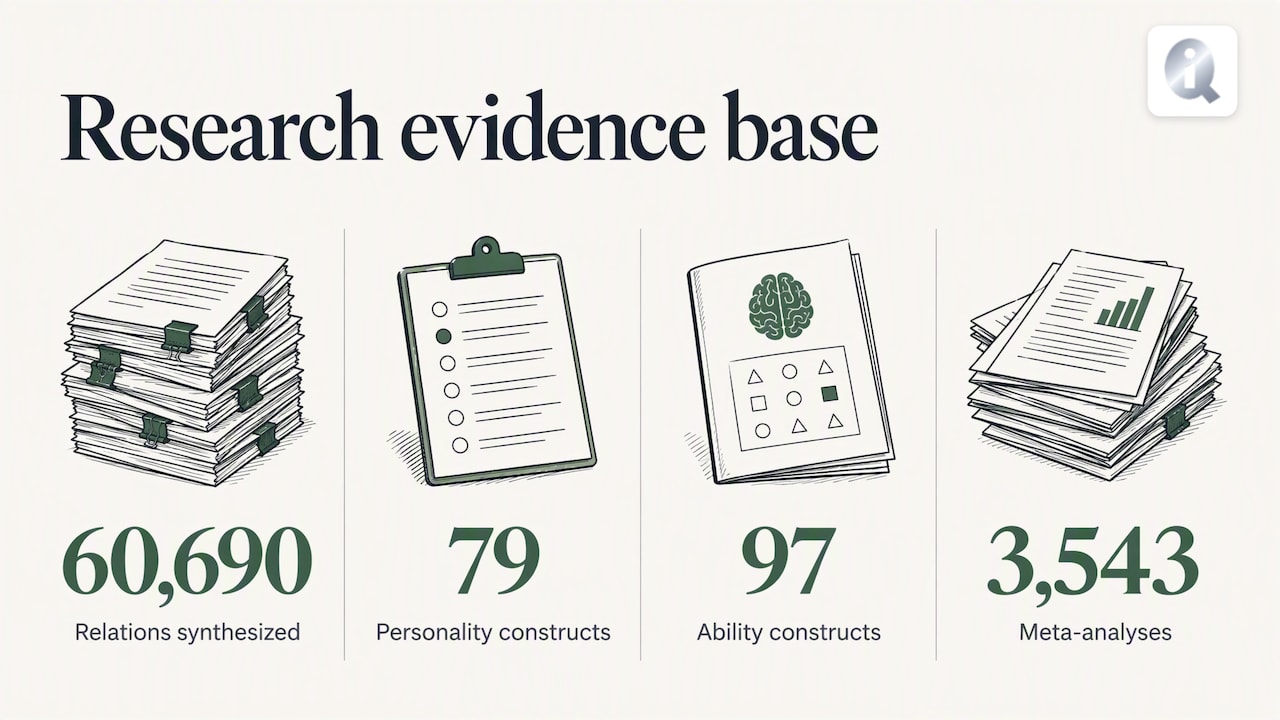
The scale of the evidence base matters here. Stanek and Ones synthesized 60,690 relations between 79 personality constructs and 97 cognitive-ability constructs, drawing on 3,543 meta-analyses. Even at that scale, many personality-ability relationships remain unestablished. Their perspective is that links become clearer at the facet level, and that focusing only on broad traits can hide both real associations and real gaps in knowledge.
How much can personality predict IQ?
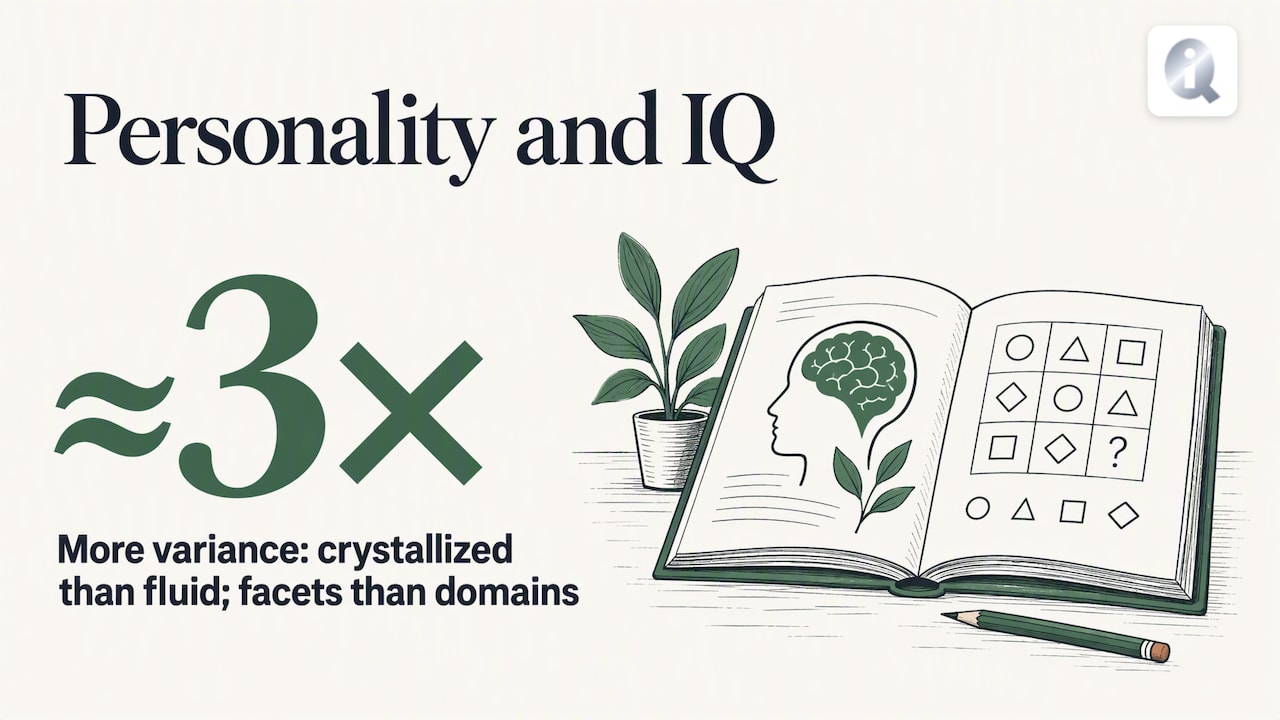
Not much, and unevenly. In a study of 365 German adults, personality explained about three times more variance in crystallized than in fluid intelligence, and facets explained more variance than broad domains. Crystallized intelligence reflects accumulated knowledge, which is shaped by curiosity and habits of learning, so a larger personality share there is plausible. Fluid reasoning is less tied to temperament.
Which Personality Type Has the Highest IQ?
None can be said to. Type labels collapse continuous traits into categories, and the correlations above are too small and too variable to rank types by intelligence. The older literature does contain attempts: a 1977 study of 314 participants tested Eysenck’s personality types and reported that its analyses falsified the study’s hypotheses, with stable and neurotic extraverts showing the best results. A single small, decades-old study is not a basis for a ranking.
The same reasoning applies to lists of “habits of high-IQ people” or to guesses about the scores of famous individuals. Without a verified test result, an IQ attributed to a person is speculation. If you want to see how published estimates are organized, our IQ comparison tool presents them with their context.
There is a related point about category-based models. Our analysis of Big Five versus MBTI predictive accuracy explains why trait-based measurement offers more information than four-letter types, which is also why trait scores are the unit researchers use when they compare personality with ability.
Does Personality Cause IQ, or the Reverse?
The data are correlational, and the direction of influence is hard to establish. Two strands of evidence point at shared origins rather than one trait driving the other.
- Genetics. The 2012 twin study found that genetic factors explained nearly all of the covariance between personality traits and IQ. Personality traits have estimated heritabilities of 30% to 60%, with Openness and Extraversion often the most heritable.
- Measurement overlap. Because personality can affect performance on cognitive tests and cognitive ability can affect item responses on personality tests, findings often reflect both the constructs and the measurement methods.
A reasonable reading: shared genetic and developmental influences, plus some measurement overlap, produce small correlations. Neither score should be used to infer the other for an individual.
Effort, Organization, and the Compensation Hypothesis
Some studies find a negative association between intelligence and Conscientiousness. One speculation is that lower-IQ individuals may compensate by being more hard-working, organized, and self-disciplined across adulthood. This is a hypothesis, not a settled finding, and it should not be read as saying that conscientious people are less capable.
What it does suggest is that cognitive ability and work habits are separable resources. Habits can be trained: learning how working memory limits what you can absorb at once, for example, helps you structure study sessions, and a guide to cognitive load theory for students explains how. Whatever your IQ score, organized effort is a lever you control.
Measuring Personality Beyond Self-Report
Because personality instruments rely on how people describe themselves, they carry the biases of self-perception. Some researchers and instructors therefore look at observed behavior in tasks and group settings. A practical example is structured feedback among teammates, covered in a guide to fair peer evaluation in group projects. Combining self-report with observed behavior gives a fuller view than either alone.
What We Think: Reading Both Scores Together
Our view at IQ Career Lab follows from the evidence above. Because the correlations between personality and cognitive ability are modest and facet-dependent, neither assessment can stand in for the other. Someone with a high Openness percentile cannot assume a high IQ, and someone with an average IQ is not constrained to a particular temperament.
That is the reason we built the two assessments separately. The 50-question IQ assessment reports cognitive ability, and a separate Big Five assessment reports OCEAN trait percentiles. Used together, they describe capacity (what you can do at your best) and style (what you tend to do day to day). Career decisions benefit from both: the cognitive demands of a role and the working style it rewards are different questions, and a result on one cannot answer the other.
We also think the research supports reading results at the right resolution. A broad category tells you where you sit; domain scores and trait facets tell you why. That is why our paid reports focus on the domain breakdown, percentile context, and a detailed personality profile rather than a single number. For a theoretical frame that goes beyond test scores, see our explainer on Sternberg’s triarchic theory of intelligence.
— Steve
Take Both Assessments
If you want to see your own profile rather than read about averages, the two assessments work independently. You can complete the 50-question IQ assessment without creating an account and see a broad result category. Unlocking the exact IQ score, percentile context, five-domain breakdown, personalized report, verifiable certificate, and Career Matches costs $9.99 once per completed result, and it is not a subscription.
The Big Five personality assessment requires sign-in and gives you OCEAN trait percentiles and a personality archetype for free. Personality Full Access costs $14.99 once per result and adds a detailed personality profile, workplace-fit insights, and a verifiable certificate. You can compare both options on the pricing page.
How to Interpret Your Two Results
- Read each score on its own terms. Your IQ result describes performance on timed reasoning tasks. Your Big Five percentiles describe tendencies, not abilities.
- Look for the facet, not the label. A trait percentile near the middle can hide a high facet and a low one. Detailed profiles exist for that reason.
- Do not infer one from the other. An Openness percentile of 90 does not imply a high IQ, and the reverse is equally true.
- Consider the testing conditions. Fatigue, anxiety, and low motivation can all influence results, which the research above shows can bleed across both kinds of measures.
- Use the pair for career thinking. Compare the cognitive demands of roles with the work style you report. Our Career-IQ Matcher and further articles on the IQ and career research blog are built for this step.
FAQ
What personality traits are linked to high IQ?
Openness is the most consistent, with a meta-analytic correlation of .26 with general mental ability. Neuroticism usually shows a negative relationship. Conscientiousness, Extraversion, and Agreeableness vary by study, and the direction often depends on the facet and the cognitive ability measured.
Does a high IQ mean a certain personality?
No. The correlations are modest, so people with similar IQ scores differ widely in personality. Genetic influences appear to account for much of the overlap between the two, but the overlap is too small to predict an individual’s personality from an IQ score.
Is personality or IQ more important for career success?
The research summarized here does not rank them, and we do not make that claim. They capture different things: cognitive ability describes how well you perform on demanding reasoning tasks, while personality describes habits and style. Looking at both gives a fuller picture when you consider a role.
Can you test IQ and personality together?
Yes, though they are different instruments with different formats. On IQ Career Lab, the IQ assessment and the Big Five assessment are separate, so you can take either one first and compare the results afterward.
Sources
- The Personality Project: Personality and ability
- Ability Tests Measure Personality, Personality Tests Measure Ability (PMC)
- Meta-analytic relations between personality and cognitive ability (PMC)
- Openness to experience, intellect, and cognitive ability (PubMed)
- The relations between cognitive ability and personality (Wiley)
- IQ in Adolescence and Cognition over 50 years later (PMC)
- The five factor model of personality and intelligence: A twin study (ScienceDirect)
- The Relation of Personality and Intelligence (PMC)
- Relationships between Personality and Cognitive Ability (PMC)
- Relationship between Eysenck’s personality types and intelligence (PubMed)