Sternberg's Triarchic Theory of Intelligence Explained

Sternberg’s Triarchic Theory of Intelligence Explained
The triarchic theory of intelligence, proposed by Yale psychologist Robert J. Sternberg in 1985, holds that intelligence is not one general ability but a system of three largely distinct abilities: analytical, creative, and practical. Each is applied to the internal world of the person, to experience, and to the external environment. The theory was built to explain why a conventional IQ score captures only part of how people succeed, and this article sets out what it claims, how its parts fit together, where it has been criticized, and how to use it when you interpret an IQ result.
TL;DR
- The American Psychological Association defines the theory as three key abilities (analytical, creative, practical) that are largely, though not entirely, distinct.
- “Three parts” can mean two things: the three abilities, or Sternberg’s three formal subtheories (componential, experiential, contextual). They answer different questions.
- Practical intelligence, according to Sternberg’s 2021 review, correlates only weakly with general intelligence and can add predictive information when both are assessed.
- A standard IQ test mainly samples analytical reasoning. It does not measure all three abilities, and no online calculator should be read as if it did.
Table of Contents
- What the Theory Claims
- The Three Abilities: Analytical, Creative, and Practical
- The Three Subtheories
- How It Differs From Conventional IQ
- Evidence and Criticism
- Beyond Three: Successful Intelligence, WICS, and Wisdom
- Applying the Theory: School, Work, and Self-Assessment
- Our Perspective
- Where Our Assessments Fit
- Common Misreadings to Avoid
- Frequently Asked Questions
- Sources
What the Theory Claims
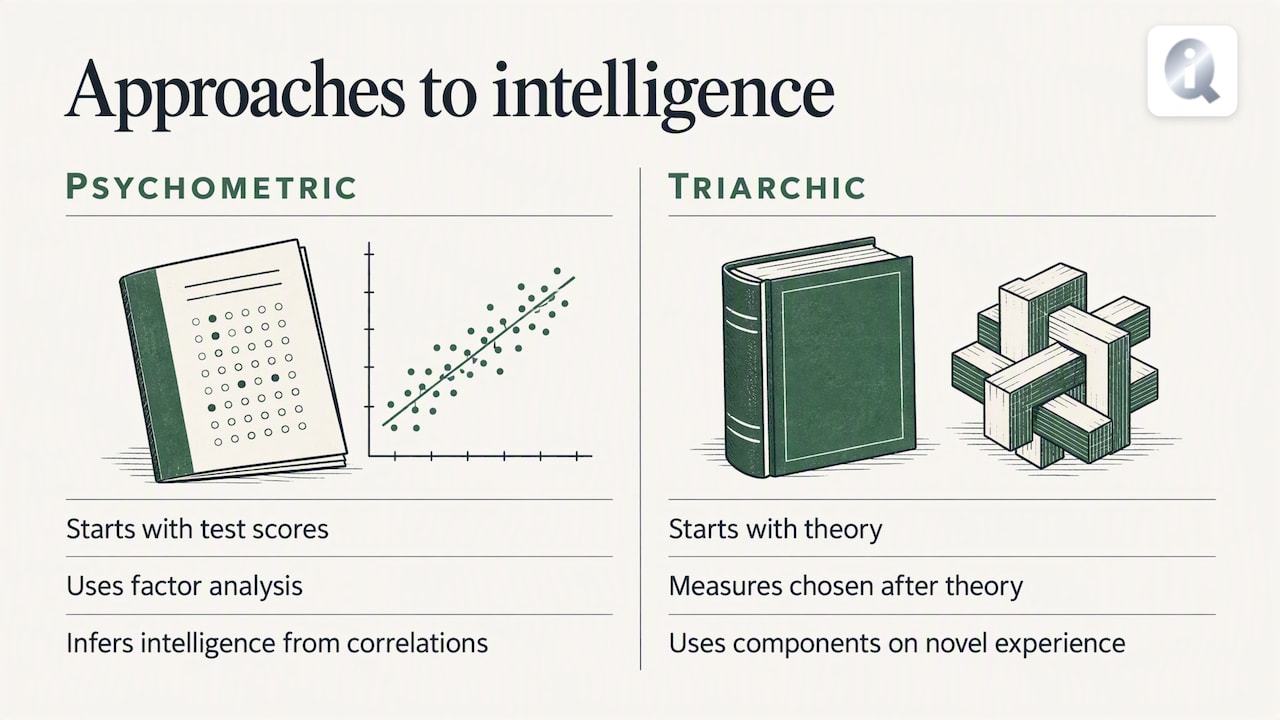
Sternberg’s 1985 article in Science (published December 6, 1985) organized theories of intelligence around three questions: how intelligence relates to the internal world of the individual, to the external world, and to experience. Earlier psychometric approaches began with test scores and used factor analysis to infer what intelligence might be. Sternberg reversed the order. As the 1997 chapter record on PsycNET describes it, the theory is a systems approach in which many aspects of intelligence are interrelated, and the measurements were chosen after the theory, not derived from it.
The practical consequence is a different definition. On this view, intelligence is the use of information-processing components on experience, particularly novel experience, in order to adapt to, shape, or select real-world environments. A person who solves abstract puzzles quickly and a person who repairs a failing project under budget pressure are both exercising intelligence, but not necessarily the same kind.
The Three Abilities: Analytical, Creative, and Practical
The popular version of the theory names three abilities. The OpenStax Psychology 2e textbook gives the standard framing, and the table below summarizes it.
| Ability | What it does | Typical tasks | Example |
|---|---|---|---|
| Analytical | Analyzes, evaluates, compares, contrasts | Academic problems, standard test items | Judging which of two arguments in an essay is better supported |
| Creative | Imagines, invents, designs a novel solution | Open-ended or unfamiliar problems | Improvising a shelter or a workaround when standard equipment is missing |
| Practical | Applies experience-based knowledge to make a solution work | Everyday and workplace problems | Knowing how to get a proposal approved by a skeptical manager |
Analytical intelligence
This is the ability closest to what conventional IQ tests sample: breaking a problem into parts, judging evidence, and reasoning toward a correct answer. Vocabulary, matrix reasoning, and arithmetic problems draw heavily on it. Sternberg did not dismiss it. He treated it as one of three necessary abilities, and the one that school and standardized testing reward most consistently.
Creative intelligence
Creative intelligence handles novelty: generating ideas, seeing problems from an unusual angle, and working with situations that no prior routine covers. In the theory’s terms, it is tied to how people deal with new tasks and how they make a skill automatic once it is learned.
Practical intelligence
Practical intelligence is the most frequently misunderstood. It is not a polite synonym for street smarts, or social confidence, or a high IQ. In the 2021 review in Education Sciences, Sternberg describes it as applying, using, implementing, and persuading, and as developing from tacit knowledge: the often unspoken understanding of how things get done under real constraints. The same review reports that practical intelligence is only weakly correlated with general intelligence, and that assessing it alongside general intelligence can improve prediction of external success criteria.
That last claim is a research finding about practical intelligence as a construct. It is not evidence that any particular online test measures all three abilities validly.
The Three Subtheories
The second meaning of “triarchic” is structural. In the original synopsis in Behavioral and Brain Sciences, the theory comprises three subtheories. Each one corresponds to one of the three questions from the 1985 framing.
| Subtheory | Question it answers | Core idea |
|---|---|---|
| Componential | What happens inside the mind? | Mental mechanisms that plan, execute, and acquire knowledge |
| Experiential | How does experience shape performance? | Novelty and automatization |
| Contextual | How does intelligence fit the environment? | Adaptation, shaping, and selection of environments |
Componential subtheory: the internal mechanisms
The componential subtheory specifies three kinds of components. Metacomponents plan, monitor, and evaluate. Performance components carry out the plan. Knowledge-acquisition components selectively encode, combine, and compare new information.
This breakdown matters for interpretation. A person may be good at generating a solution but weaker at evaluating it, or good at evaluating but slow to implement. A single composite number hides those differences.
Experiential subtheory: novelty and automatization
Intelligence shows most clearly at two points on the continuum of experience: when a task is new, and when a practiced task has become automatic. Handling novelty draws on creative ability. Automatizing a routine frees working capacity for the next problem.
Contextual subtheory: fit with the environment
The contextual subtheory says that what counts as intelligent behavior depends on the setting. It names three responses: adapting to an environment, shaping it to fit your goals, or selecting a different environment altogether. Someone who leaves a role that does not suit their strengths for one that does is, in this account, acting intelligently.
Which “three” are you being asked about?
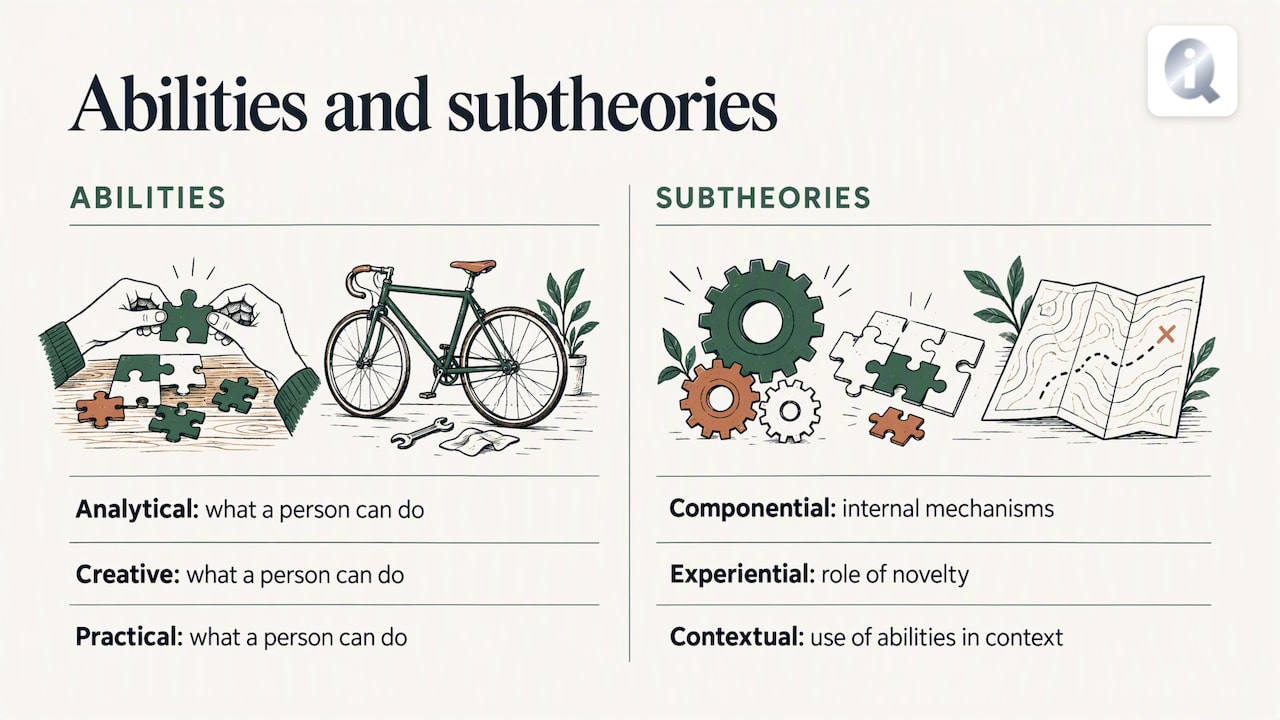
Students often lose marks by mixing the two lists. The abilities (analytical, creative, practical) are what a person can do. The subtheories (componential, experiential, contextual) explain the internal mechanisms, the role of novelty, and the use of those abilities in context, as the APA Dictionary entry and the original synopsis both indicate. Answer the question with the list it asks for, and say how the two relate when you can.
How It Differs From Conventional IQ
A traditional IQ score is built from performance on a battery of tasks and summarized relative to a population norm. We discuss the meaning of that norm in our article on why 100 is a norm, not a national score. The triarchic theory does not say that this score is meaningless. It says the score is mostly an index of analytical performance on tasks with a single correct answer and a clear time limit.
Three differences stand out:
- Scope. The triarchic theory includes novelty handling and real-world implementation, which most timed test items do not sample.
- Direction of reasoning. The theory came first and tests were designed to fit it. Psychometric models started from test correlations.
- Independence. Sternberg argues the three abilities are largely distinct. Mainstream psychometrics emphasizes a general factor that runs through most cognitive tasks.
OpenStax draws an interpretive consequence worth remembering: practical intelligence can be separate from traditional IQ performance, so a person may show strong everyday problem solving without an equivalent score on analytical or conventional academic measures.
Evidence and Criticism
A balanced account has to include the debate. The theory is widely taught, and it has produced applied research. One example is the Rainbow Project, which used the theory as a basis for supplementary assessments of analytical, practical, and creative skills intended to augment the SAT in predicting college performance.
The main objections, which we state as general positions in the field and not as findings of any one study, are these:
- Overlap with general intelligence. Critics argue that measures of the three abilities still correlate positively with each other and with conventional tests, which would point toward a shared general factor.
- Measurement. Practical intelligence is harder to score than vocabulary or matrix items, because tacit knowledge is tied to a context and a scoring key needs expert agreement.
- Scope of predictive gain. Incremental prediction beyond general intelligence is a claim that needs replication across populations and criteria.
Sternberg’s own position, as the 2021 review states it, is that practical intelligence is weakly correlated with general intelligence and adds information. Whether you find that persuasive depends on how you weigh general-factor models against domain-specific ones. The honest summary is that the theory is influential and useful for thinking about success, while its claim of three independent abilities remains contested.
Beyond Three: Successful Intelligence, WICS, and Wisdom
Sternberg later extended the framework. The meta-intelligence paper in PMC describes the WICS model, which adds wisdom-based approaches to creative, analytical, and practical ones, and treats problem solving as a matter of understanding, controlling, and coordinating them according to the problem and context. The “adaptive intelligence” concept in the 2021 Education Sciences review continues this line, focusing on the intelligence needed to adapt to present problems and anticipate future ones.
These are extensions. Wisdom is not one of the original three parts, and an exam answer or a summary of the 1985 theory should not list it as one.
The WICS framing does yield a useful sequence for applied work: generate ideas creatively, test them analytically, implement them practically, and consider the context in which they must work. The abilities are not isolated types. They are used in combination, and part of intelligent behavior is choosing which to use when.
Applying the Theory: School, Work, and Self-Assessment
In the classroom
The theory supports teaching and assessing in all three modes. A history unit might ask students to analyze a primary source, imagine an alternative outcome to an event, and apply the lessons to a present-day policy question. Research on triarchic teaching and assessment is a standard topic in education journals, and the common thread is that varied tasks give more students a chance to show what they can do.
At work
Many jobs require more than correct analysis. An intelligence analyst must evaluate sources (analytical), consider hypotheses nobody has proposed (creative), and get a briefing accepted by decision makers (practical). A school counselor needs analytical grasp of data on a student, creative flexibility in a new situation, and tacit knowledge about how a school system actually operates. If you are curious about the cognitive demands of specific roles, our pages on whether you are smart enough to be an intelligence analyst, the published average IQ estimate for intelligence analysts, and school counseling lay out the figures and their limits.
Reading your own profile
Using the theory sensibly means holding two ideas at once. First, one number rarely describes a person. Second, a profile of strengths is only as good as the measurement behind it. A free tool such as our Cognitive Strength Finder can show which cognitive domains you lean toward, and that is useful for reflection. It is not a test of Sternberg’s three abilities, and we do not present it as one.
Our Perspective
At IQ Career Lab, we build assessments, so we have a stake in how this theory is read. We think the triarchic theory is most valuable as a correction to overconfidence, in both directions.
It corrects the belief that a single IQ score settles what a person can do. Our own assessment is a 50-question test that reports results across five cognitive domains, and we report domain-level breakdowns precisely because one composite number hides variation. It also corrects the opposite error, the claim that tests are irrelevant. Analytical reasoning is a real ability, it is measurable, and it matters in many educational and occupational settings.
What we will not claim is that our assessment captures creative or practical intelligence in Sternberg’s sense. Tacit knowledge and real-world implementation are not something a 50-question online test can sample well, and our results are intended for informational and personal-development purposes, not clinical diagnosis or formal employment qualification. We encourage readers to treat a cognitive score as one input, together with personality, experience, and context. That is why we also offer a Big Five personality assessment, and why we explain in our post on personality test accuracy what the evidence does and does not show.
— Steve
Where Our Assessments Fit
If you want a structured look at your analytical reasoning and its component domains, you can start our Full IQ Assessment without registering and receive an initial result range. The Full IQ Result is a one-off $9.99 and unlocks your exact score, percentile context, and domain breakdown. If you also want to understand the dispositional side of how you work, the Big Five Personality test is available, and Personality Full Access is a one-off $14.99 on the same pricing page. Both are calibrated against established psychometric norms, and neither is a substitute for professional evaluation when a clinical or legal decision depends on the result.
Common Misreadings to Avoid
- “People are one of three types.” The theory describes abilities that everyone uses in combination, not categories into which people are sorted.
- “Practical intelligence means a high IQ is unnecessary.” The claim is that it is weakly correlated with general intelligence and can add prediction, not that analytical ability is irrelevant.
- “Wisdom is the fourth part.” It belongs to later extensions such as WICS.
- “An online quiz can tell you your triarchic profile.” Only instruments designed and validated for these constructs can support such a claim, and most consumer quizzes are not.
Frequently Asked Questions
What are the three parts of Sternberg’s triarchic theory?
The commonly cited parts are analytical, creative, and practical intelligence. Formally, the theory has three subtheories: componential (internal mental mechanisms), experiential (novelty and automatization), and contextual (fit with the external environment). The first list names abilities, and the second explains how they operate.
Who introduced the triarchic theory of intelligence?
Robert J. Sternberg, then at Yale University, proposed it in 1985. The APA Dictionary dates the theory to that year, and his Science article that December set out its three guiding questions. He has since extended it into the theory of successful intelligence and the WICS model.
Can you give an example of each type of intelligence?
Analytical intelligence is comparing two arguments and judging which is stronger. Creative intelligence is improvising a workable solution when standard tools are missing. Practical intelligence is knowing how to make that solution fit real constraints and convince others to adopt it. Most real tasks use all three.
Is the triarchic theory a replacement for IQ?
No. It is a broader account of intelligence that treats IQ-style performance as mostly analytical. Sternberg argues that practical intelligence adds predictive information when assessed alongside general intelligence, but the theory is debated, and conventional measures remain widely used.
Sources
- APA Dictionary of Psychology: triarchic theory of intelligence
- Toward a triarchic theory of human intelligence, Behavioral and Brain Sciences
- The triarchic theory of intelligence, PsycNET record
- Adaptive Intelligence: Its Nature and Implications for Education, Education Sciences
- Human Intelligence: The Model Is the Message, Science, 1985
- OpenStax Psychology 2e: What Are Intelligence and Creativity?
- Meta-Intelligence: Creative, Analytical, Practical, and Wisdom-Based Approaches, PMC
- The Rainbow Project: Enhancing the SAT, ResearchGate