Verbal Reasoning IQ: What 100 Means, Plus Questions to Try

Verbal reasoning IQ measures how well you reason with words, drawing on vocabulary, comprehension, and the ability to see how concepts relate. It is usually reported inside a standardized IQ battery, where the average score is 100 and one standard deviation is 15 points. A verbal score is best read as one domain of a broader cognitive profile.
TL;DR:
- Favor the Verbal Comprehension Index over any single subtest, because short subtests are less reliable; online quizzes provide only rough estimates.
- Scores from 85 to 115 include about 68% of people; scores above 115 are above average, and those near 130 reach the top few percent.
- A verbal and nonverbal gap of about 15 points or more is commonly flagged, but it usually signals a relative strength, not a deficit.
- Second language proficiency, schooling, and cultural familiarity can affect verbal results, so interpret scores cautiously when the test language or references are unfamiliar.
- Practice with unfamiliar topics, learn vocabulary in context, review missed answers, and use timed sets without a dictionary; one short practice score is noisy.
Table of Contents
- What does verbal IQ actually measure?
- How do tests measure verbal ability?
- How should you interpret a verbal IQ score?
- What does a gap between verbal and nonverbal IQ mean?
- What are the signs of high verbal IQ?
- What do verbal reasoning practice questions look like?
- Which cognitive processes drive verbal reasoning?
- Which verbal question formats go beyond analogies and vocabulary?
- How do education, culture, and language proficiency affect verbal IQ?
- How can you improve verbal reasoning over time?
- Using a verbal IQ result responsibly
- Where can you get a detailed verbal-domain breakdown?
- FAQ
- Sources
What does verbal IQ actually measure?
Verbal IQ captures how well you handle knowledge and reasoning expressed in language. Most of what it picks up is tied to crystallized knowledge: what you have learned and can apply through words. That is why vocabulary often dominates the verbal index. Research on vocabulary and intelligence found that vocabulary scores correlate strongly with verbal IQ, with a correlation of .80 with WISC-III Verbal IQ and .83 with the Verbal Comprehension Index. Separate work reports that verbal ability can account for 20% to 50% of the variance in general intelligence measures, depending on the model.
A verbal-domain result typically reflects these component skills:
- Vocabulary: knowing word meanings and using them precisely.
- Comprehension: understanding explanations, instructions, and social or practical situations expressed in words.
- Similarities: seeing what two different concepts have in common.
- Information: general knowledge acquired through schooling and experience.
Scholarly work also argues that vocabulary acquisition reflects general mental ability more than most other abilities in a test battery. In plain terms, a rich vocabulary is rarely just about words.
How do tests measure verbal ability?
Wechsler-style batteries build the verbal score from a few subtests: vocabulary, similarities, and information or comprehension. Those subtest results combine into a Verbal Comprehension Index, which is the number that matters most. Individual subtests are shorter and less reliable than the composite, so the index deserves more weight than any single subtest.
Online quizzes and screening tools usually borrow the same ideas in a lighter form. Expect these item types:
- Synonym or vocabulary multiple choice: pick the word closest in meaning to a target word.
- Analogies: complete a relationship such as “pencil is to write as knife is to ___.”
- Sentence meaning or implication: decide what a short statement suggests or what follows from it.
- Brief reading comprehension: read a short passage and answer a question about it.
A short online quiz gives a rough signal at best. A fuller assessment samples more item types and produces a more stable estimate, which is why we report a domain breakdown instead of a single number in our Full IQ Assessment.
How should you interpret a verbal IQ score?
Start with the scale. On most modern standardized tests, the mean is 100 and one standard deviation is 15 points, so scores between 85 and 115 encompass about 68% of the population. Roughly two out of three people land in that band, which makes it the typical range.
Above that band, a verbal score of 115 or higher is usually described as above average, and scores near 130 sit in the top few percent. Percentiles translate the same idea: a score of 100 is the 50th percentile, and each band above it covers a smaller slice of the population. Our IQ score meaning tool turns a number into a descriptive band, and the standard deviation calculator shows where it falls on the bell curve.
Key figure: one standard deviation is 15 points, and 68% of people score between 85 and 115. A “good” verbal score is relative to that curve, not to a fixed target.
For anything that matters, favor the index or composite score over one short subtest.
What does a gap between verbal and nonverbal IQ mean?
Verbal tasks rely on words and learned knowledge. Nonverbal tasks rely on patterns, shapes, and abstract reasoning that do not need language. Most people score somewhat differently on the two, and a difference of about 15 points or more is commonly flagged as notable. A flagged gap is usually a relative strength, not a deficit. Practitioners caution against over-interpreting a single Full Scale IQ when the indices differ widely, and a profile with high verbal ability and average nonverbal reasoning often reflects personal strengths.
Here is where each strength tends to pay off:
- Strong verbal profile: drafting contracts, teaching, editing, negotiating, and any work built on explaining ideas clearly.
- Strong nonverbal profile: diagrams, spatial design, debugging systems, and tasks where the pattern matters more than the wording.
- Balanced profile: flexibility across both, often useful in roles that mix analysis and communication.
What are the signs of high verbal IQ?
Test findings show up in everyday habits. People with high verbal ability often share several of these traits:
- A large active vocabulary, including precise words for fine distinctions.
- Ease reading dense material and retaining its main argument.
- Persuasive writing and clear, structured argument.
- Quick grasp of analogies and figurative language.
These strengths tend to predict success in language-heavy subjects and fit careers in law, teaching, and communications.
Pro Tip: Ask whether a strong verbal score reflects underlying skill or simply heavy exposure to reading and schooling. Try unfamiliar topics and new vocabulary: if you still reason well there, the skill is real.
What do verbal reasoning practice questions look like?
Try these. Answers follow the list.
- Which word is closest in meaning to “terse”? (a) lengthy (b) brief © angry (d) vague
- Which word is closest in meaning to “ambivalent”? (a) uncertain (b) cheerful © hostile (d) tidy
- Which word is the opposite of “scarce”? (a) rare (b) plentiful © costly (d) hidden
- Doctor is to hospital as teacher is to ___. (a) school (b) lesson © student (d) book
- Which word is closest in meaning to “meticulous”? (a) careless (b) thorough © quick (d) loud
- “The report was hardly flattering.” What does this imply? (a) It praised the team (b) It was critical © It was short (d) It was late
- Which word is the opposite of “benevolent”? (a) kind (b) generous © malicious (d) calm
Answers: 1b, 2a, 3b, 4a, 5b, 6b, 7c.
Study tactics that work: learn words in context rather than from lists, review them with spaced repetition, read across genres, practice under a timer, and read every explanation for the items you miss. For multiple-choice practice, this guide to exam question types explains how to use answer options effectively.
Pro Tip: Simulate test conditions with a set time limit and no dictionary. Treat one practice score as a rough signal, not a verdict, since small sets of questions are noisy.
Which cognitive processes drive verbal reasoning?
Verbal reasoning is not a single skill. It leans on several processes working together, and a weakness in one can pull down a score that looks like a language problem.
Language comprehension comes first: decoding words and sentence structure quickly enough that meaning is available for reasoning. Slow or effortful decoding eats attention that the reasoning step needs.
Working memory holds the pieces of a problem in mind. In an analogy or a multi-sentence passage, you keep the first relationship active while you test candidate answers. People who lose track of the premise often miss items they could otherwise solve.
Semantic processing is how you retrieve and compare word meanings. Strong semantic networks let you see that “reluctant” and “hesitant” overlap, or that “hammer” and “saw” are both tools. This is where vocabulary breadth turns into reasoning power.
Knowledge retrieval pulls facts from long-term memory, which is why the information subtest rewards a broad education. Add attention and processing speed, and the picture is clear: a verbal score reflects a system, not a word list.
This is also why verbal reasoning is most informative alongside fluid reasoning, spatial skill, and processing speed. A broader profile explains more than one domain can.
Which verbal question formats go beyond analogies and vocabulary?
Many reasoning batteries include formats that test logic carried through language. Knowing them removes the surprise on test day.
Syllogisms give two premises and ask what follows. “All analysts are careful. Some careful people are slow. Which conclusion is certain?” The trap is accepting a conclusion that sounds plausible but is not forced by the premises.
Logical deductions use short statements about people, order, or rules. If Maya finished before Leo, and Leo finished before Sam, who finished last? You build a chain and read off the answer.
Pattern recognition in verbal data asks you to spot a rule in a sequence of words or categories, such as which word does not belong in a group and why.
Inference and “must be true” items present a short passage and ask which statement the text supports. The key habit is separating what the passage states from what you assume.
Sentence completion needs both vocabulary and logic: the right word must fit the meaning and the grammar of the sentence.
For these formats, slow down on the premises and rule out answers that go beyond the given information. They reward careful reading more than a large vocabulary.
How do education, culture, and language proficiency affect verbal IQ?
Verbal tests measure learned language, so they inevitably reflect the learning environment. Education matters because schooling builds vocabulary and background knowledge. Reading habits at home, access to books, and years of instruction all feed the verbal index.
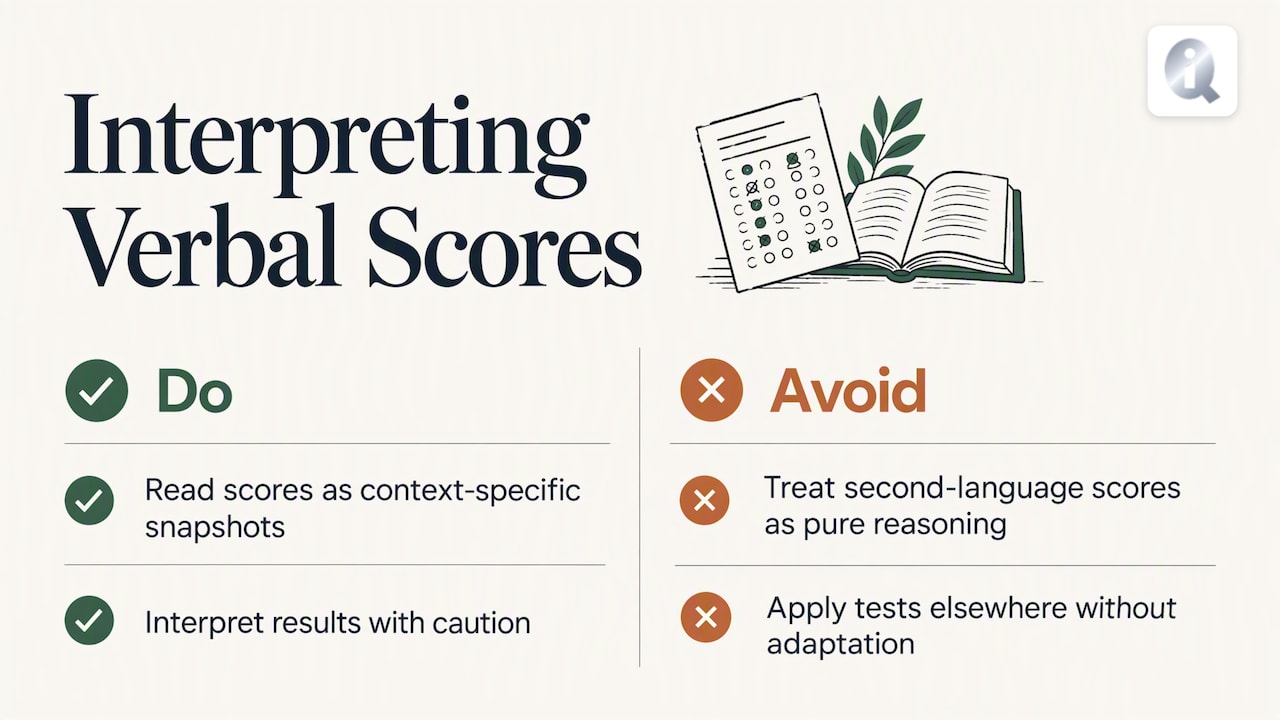
Culture matters because tests are written inside one. Researchers argue that ability assessments are cultural genres that reflect the communication conventions of the culture that produced them, so using them elsewhere requires adaptation and careful interpretation. An idiom or reference that is obvious in one setting can be opaque in another.
Language proficiency is the most direct factor. Someone taking a test in a second language is measured partly on proficiency, not only reasoning. A lower verbal score for a person still learning English says little about how well they think.
Professional guidance points the same way. The American Psychological Association stresses that professionals should interpret results with caution because mean scores can differ across populations, and cultural exposure, education, and linguistic demand all affect interpretation.
The practical lesson: read a verbal score as a snapshot of language-based reasoning in a specific context. If your background differs from the test’s, treat the number with extra care.
How can you improve verbal reasoning over time?
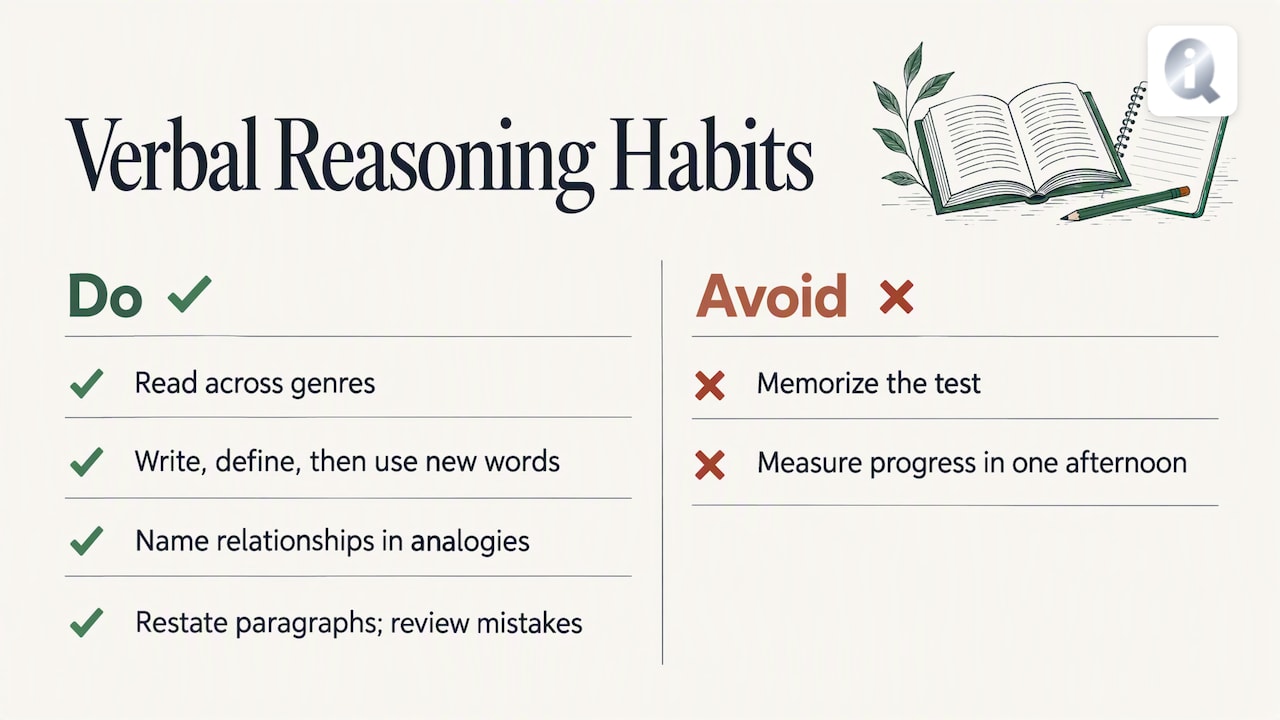
Verbal reasoning responds to steady habits more than to tricks. The goal is to grow the underlying knowledge and processing skills, not to memorize a test.
Read widely and often. Mix fiction, journalism, essays, and technical writing. Each genre exposes you to different vocabulary and argument structures, which builds both knowledge and comprehension.
Learn words actively. When you meet an unfamiliar word, write the sentence you found it in, look up the definition, then use the word yourself within a day or two. Space your reviews over days and weeks.
Practice analogy and relationship thinking. Ask how two things connect: part to whole, cause effecting, tool to task. Naming the relationship trains the exact skill analogy items test.
Write and argue. Summarize an article in three sentences, then state the author’s main claim and one weakness. Writing forces precision that passive reading does not.
Work your working memory. Read a paragraph, close it, and restate it from memory. This builds the ability to hold premises while reasoning.
Review mistakes. After each practice set, understand why the right answer is right.
Progress is gradual. Vocabulary and knowledge accumulate over months, so measure change over weeks, not a single afternoon.
Using a verbal IQ result responsibly
A verbal score is a useful indicator, not a label. Treat it as one domain inside a wider profile, and weigh it against nonverbal reasoning, memory, and speed. If you want deeper insight, a full domain breakdown is a sensible next step, and a formal diagnostic evaluation is the right route if you have clinical questions. Our tools can give you an accessible domain breakdown for personal development, without implying any clinical diagnosis.
— Steve
Where can you get a detailed verbal-domain breakdown?
If you want more than a single number, our Full IQ Assessment is a 50-question test you can start without registering. It gives you an initial result range, and you can unlock a detailed report with your exact score, percentile context, and a breakdown across cognitive domains, with a verifiable certificate. The Full IQ Result is a one-off $9.99.
Use the report to compare your verbal strength with your other domains, then explore how that profile lines up with career options. Our assessments are for informational and personal-development purposes, not clinical diagnosis. Start the assessment, check your range, and decide whether the full report is worth it for you.
FAQ
What is a good verbal IQ score?
A score of 100 is average, and 85 to 115 covers about 68% of people. Scores above that range are above average, and the higher the score, the smaller the share of people who reach it.
What are some signs of high verbal IQ?
Common signs include a large active vocabulary, easy reading comprehension, and clear, persuasive writing. People with high verbal ability also tend to pick up analogies and nuance quickly. Check that the skill holds up on unfamiliar topics, not just familiar ones.
What is the rarest type of intelligence?
Psychometrics does not rank types of intelligence by rarity. What can be said is that very high scores in any single domain are uncommon by definition, since each step above the mean covers fewer people. Profiles with exceptional strength in one domain are simply less frequent.
How does vocabulary relate to verbal IQ?
Vocabulary is among the strongest predictors of verbal IQ. One study found vocabulary measures correlated r = .80 with WISC-III Verbal IQ. That is why vocabulary often dominates a verbal index.
Sources
- 7.5 Measures of Intelligence - Psychology 2e | OpenStax
- Pubmed
- Relationship between intelligence and vocabulary - PubMed
- YOU CAN’T TAKE IT WITH YOU: Why Ability Assessments Don’t Cross Cultures