IQ Test Time Limits: How Long You Get and Why

There is no single time limit for IQ tests. Each test sets its own rules: a clinician-administered Wechsler scale takes roughly 45 to 60 minutes for its core score, some individual subtests are timed to the second, and many power-style tests allow generous or open-ended time. What matters for your score is whether a test is speeded (the clock changes who scores higher) or unspeeded (extra time would not change anyone’s standing). This article explains the difference, shows what the published figures say, and tells you what to do when the clock runs out.
TL;DR
- No universal limit exists. The WAIS-5 takes about 45 minutes for its seven-subtest full-scale score and about 60 minutes for the 10 primary index subtests, per the publisher.
- Many tests combine timed and untimed tasks. A time limit can turn a reasoning test partly into a test of working pace.
- Research reviews find that even mild time pressure changes how people respond: faster answers, more guessing, lower confidence.
- The Mensa admission test is timed, but its published session length includes registration and is not the per-test limit.
- Before you start any online test, check three things: the stated time per section, whether unanswered items count as wrong, and whether the result is a standardized score.
Table of Contents
- Is there a standard time limit for an IQ test?
- How long common IQ tests take
- Speed tests versus power tests
- What a time limit does to your score
- Are IQ tests timed, and what happens if you do not finish?
- Are Mensa IQ tests timed?
- Why online IQ tests feel longer than their label
- Our perspective
- Taking our IQ assessment
- How to choose a test given the time limit
- FAQ
- Sources
Is there a standard time limit for an IQ test?
No. A time limit belongs to a specific test, a specific subtest, and sometimes a specific age group. Three layers explain most of the variation:
- Total administration time. This is how long the whole session lasts, set by which composites the examiner chooses to give.
- Per-item or per-subtest limits. Some tasks, such as assembling blocks or scanning symbols, are scored partly on speed. Others, such as vocabulary, are not.
- Stopping rules. Many individually administered tests stop a subtest after a run of consecutive incorrect answers, which shortens the session for some examinees and lengthens it for others.
Pearson’s documentation for the WAIS-5, the current U.S. adult Wechsler scale (2024), shows the pattern clearly: the completion time depends on the composite selected, and optional subtests add more. Pearson also notes that special start points for examinees suspected of intellectual giftedness cut testing time by approximately 25% compared with the standard start points. In other words, even within one test, two people can finish in noticeably different times.
If you are mainly asking how long a whole sitting takes rather than how long a single question may take, our guide to IQ test length by type covers the formats side by side.
How long common IQ tests take
The table below collects the figures that can be tied to a published source. Treat them as typical ranges, not guarantees.
| Test | Typical total time | Notes |
|---|---|---|
| WAIS-5, seven-subtest FSIQ | About 45 minutes | Per the publisher’s brochure (2024) |
| WAIS-5, 10 primary index subtests | About 60 minutes | Optional subtests add time |
| WISC-IV, 10 core subtests | 72 minutes on average, range 42 to 100 | From a Journal of Clinical Psychology study (2007) |
| U.S. Mensa Admissions Test | Session of 90 minutes to two hours | Includes registration; consists of two timed tests |
Two points deserve emphasis. First, the WISC-IV study found administration time to be substantially variable, with a 58-minute spread between the shortest and longest sessions among examinees taking the same subtests. Second, these are clinician-led batteries. Online tests, which are typically self-administered and shorter, follow a different logic, covered below.
Speed tests versus power tests
This distinction answers most of what readers want to know when they search for time limits.
A power test presents items of increasing difficulty and gives enough time that nearly everyone can attempt every item they are able to solve. What separates test takers is the difficulty level they can reach. A speed test presents easy items and a time limit short enough that few people finish; what separates test takers is how many items they complete correctly.
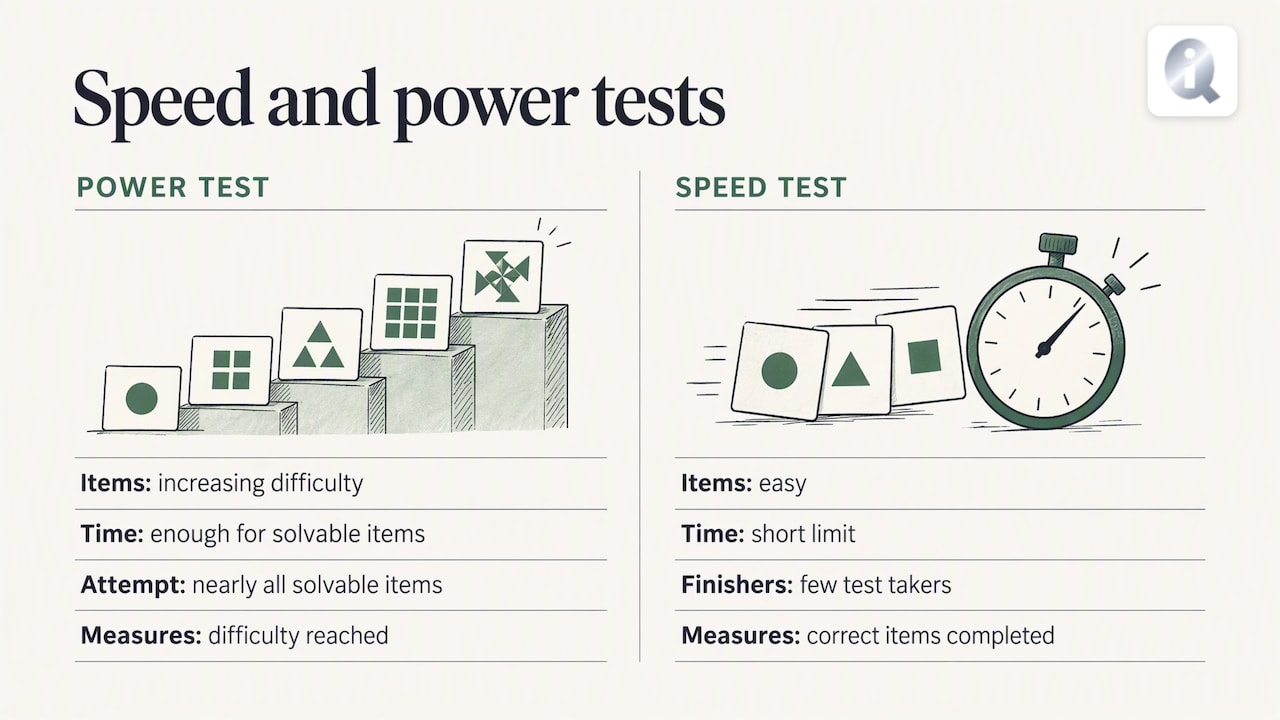
Most real tests sit between the two. A formal definition in the research literature says a test is unspeeded when no one’s standing in the group would change with additional time, and speeded to the extent that the time limit alters people’s true standard scores. That definition appears in a review of response time in cognitive ability measurement (2016), whose authors also discuss speed and level as separate performance dimensions with evidence for separate factors.
A quick comparison
| Feature | Speed test | Power test |
|---|---|---|
| Item difficulty | Mostly easy | Rises steadily |
| Time limit | Tight; few finish | Generous or none |
| Main driver of score | Pace and accuracy | Highest difficulty solved |
| Typical examples | Symbol scanning, simple arithmetic drills | Matrix reasoning, number series, verbal analogies |
| Risk | Rewards fast, shallow responses | Takes longer; can reward persistence |
What a time limit does to your score
If the aim is to estimate reasoning ability, a time limit adds a second ingredient. Corentin Gonthier’s 2023 peer-reviewed review of speeded and unspeeded intelligence tests argues that time pressure introduces a speed component and can reduce validity when the goal is to estimate intellectual ability rather than speeded performance. It reports that even mild time pressure can make people speed up more than required, lower their confidence, and adopt poorer strategies. It also describes item skipping, guessing and increased anxiety as consequences, which means a timed result is not interchangeable with an untimed one.
A separate 2020 paper on timed testing makes two further points that matter to U.S. readers:
- Untimed power tests are considered ideal for assessing complex thought processes, while time-limited tests can confound knowledge with a student’s pace of work.
- Time-limited tests are less inclusive, because students with documented disabilities are legally allowed additional test-taking time.
The New York Times reported in 2023 on the same concern in education: timed tests often reward fast, shallow reasoning over the methodical processing complex problems demand. For a deeper look at how time pressure shapes reasoning strategies and confidence on aptitude assessments, see this overview of psychometric tests for internships.
None of this makes timed tests invalid. Processing speed is itself a legitimate cognitive ability, and professional batteries include it deliberately, as one index among several. The problem arises when a single number blends speed and reasoning without telling you the weight of each.
Are IQ tests timed, and what happens if you do not finish?
Most are, at least in part. What happens next depends on the format.
Individually administered tests (Wechsler-style). The examiner times specific subtests, stops you when the limit is reached, and scores what you completed. Unfinished items are generally not credited, but on subtests without speed bonuses the limit is rarely the binding constraint. Because the examiner is present, they can note fatigue, anxiety or other circumstances that affect interpretation.
Group-administered power tests. Time is usually set so most people can finish, and the final few hard items are expected to go unanswered by many. Leaving the last items blank is normal and usually costs you little.
Online tests. There are three common arrangements: a countdown for the whole test, a timer on every question, or no timer at all. Skipped or unanswered items are almost always scored as incorrect. Before you start, find the scoring rule on the test page. If a test lacks any stated rule, treat the result as an estimate rather than a standardized score.
Practical advice for any timed section:
- Do the items you are sure of first, then return to harder ones if the format allows backtracking.
- Where wrong answers are not penalized, guess rather than leave blanks.
- Do not spend more than a small multiple of the average time per item on one problem.
- Skip the urge to rush items you already know how to solve; speed errors on easy items cost the same as errors on hard ones.
Are Mensa IQ tests timed?
Yes. San Francisco Regional Mensa describes the U.S. Mensa Admissions Test as two timed IQ tests. Its stated session length of 90 minutes to two hours covers the entire appointment, including registration, so it should not be read as the time allowed for each test. For the exact per-test limits and the current rules, check the official Mensa page for your region; they are set by the organization and can change.
Why online IQ tests feel longer than their label
A 50-question test with a posted length can still take longer in practice, because reading instructions, working through the example items and pausing between sections all add time. A lower posted figure also may not account for time spent registering or reviewing a result page. We recommend planning a quiet block of time with no interruptions, since a break halfway can matter more than a few minutes of difference on the clock.
Our own free IQ tools and calculators help you read a score once you have it, including percentile comparison, but a tool cannot repair a test taken while distracted. If you plan to retest, spacing matters: professional manuals commonly recommend waiting about a year between administrations of the same test, because familiarity with items inflates later scores.
Our perspective
We approach timing as a measurement question, not a gimmick. A score is only interpretable when you know what produced it. If a number reflects both reasoning and pace, a reader looking at that single figure cannot tell which part drove it.
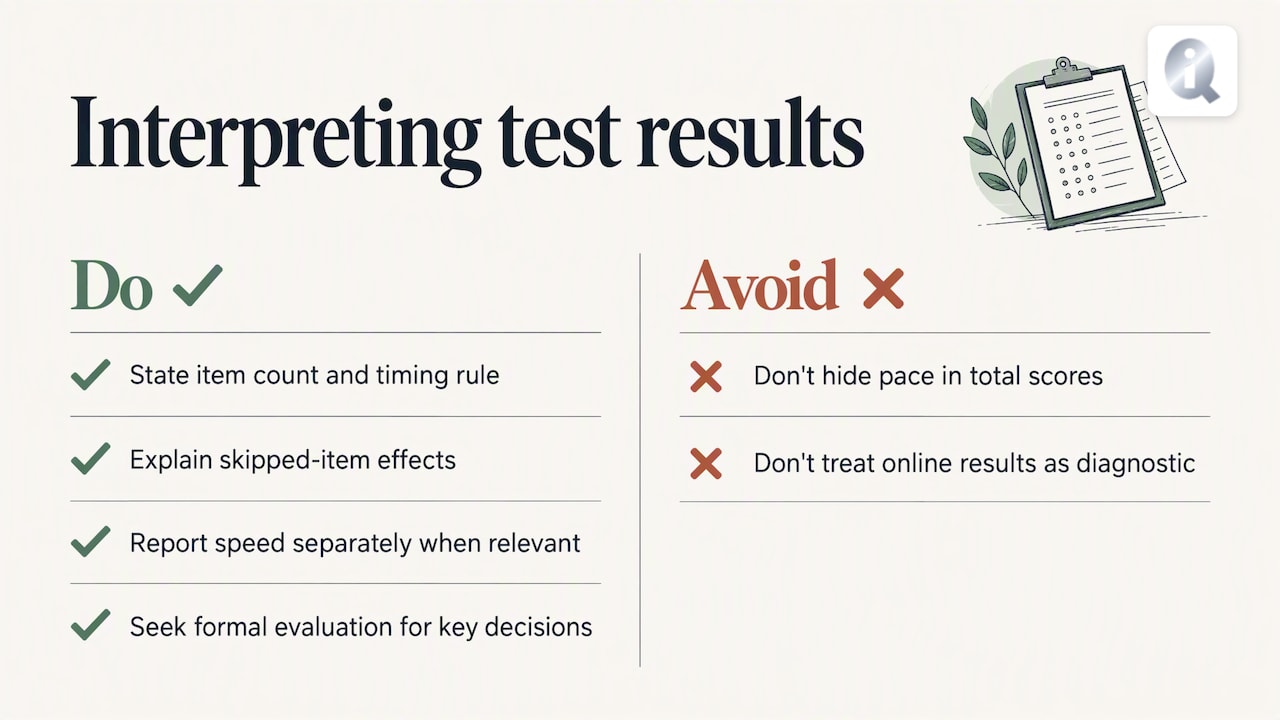
That is why we think test pages should say plainly three things: how many items there are, what the timing rule is, and what a skipped item does to the result. It is also why we separate the free broad result category from the exact score. The 50-question IQ assessment on our site requires no account, returns a broad category, and lets you decide whether to unlock the detailed result. Our view is that timing should serve the construct being measured. Reasoning items deserve enough time to be reasoned through, and speed, where it matters for a career or a study question, is better reported as its own component than hidden inside a total.
We also encourage readers to treat any online result, ours included, as informative rather than diagnostic. A formal evaluation with a licensed psychologist is the right route when a score will inform educational placement, disability accommodations or a clinical decision.
— Steve
Taking our IQ assessment
If you want to see how a self-paced format feels, you can take our 50-question IQ assessment without creating an account and receive a broad result category. Unlocking the exact IQ score, percentile context, five-domain breakdown, personalized report, verifiable certificate and Career Matches costs $9.99 once per completed result, with no subscription. You can see the details on the pricing page, or look at how the verifiable IQ certificate works first. If you are curious about work style rather than reasoning, the separate Big Five personality test is free, and Personality Full Access is $14.99 once per result.
How to choose a test given the time limit
Use these criteria to pick a test for your purpose:
- You need a formal score for school, accommodations or clinical use. Use a clinician-administered battery. Online tests are not a substitute.
- You want to understand your strengths. Choose a test that reports a domain breakdown, so speed-heavy and reasoning-heavy parts can be told apart.
- You are preparing for an employer’s aptitude screening. Practice under the same timing. Our guide to inductive reasoning practice for job applicants sets out a four-week routine, and the verbal reasoning guide shows sample questions.
- You are curious and want a rough number. Pick a test with a stated scoring rule and finish it in one sitting.
For more reading on the research side, the IQ & career research blog collects our articles on score interpretation and cognitive abilities.
FAQ
How long is an IQ test?
It depends on the test. The WAIS-5 takes about 45 minutes for its seven-subtest full-scale score and about 60 minutes for the 10 primary index subtests, according to the publisher. In a study of the WISC-IV, the 10 core subtests averaged 72 minutes and ranged from 42 to 100 minutes. Online tests vary and often run shorter.
Are IQ tests timed?
Most include some timing, although not every item is speeded. Professional batteries time certain subtests and leave others open, while many power-style tests allow enough time for most people to attempt every item. Check each test’s stated timing and scoring rules before you start.
Is a timed or an untimed IQ test better?
Neither is better in every case. Research reviews suggest untimed tests are closer to measuring reasoning alone, while timed tests add a speed component and can raise anxiety and guessing. They measure related but different things, so compare scores only between tests with the same timing rules.
Are Mensa IQ tests timed?
Yes. The U.S. Mensa Admissions Test consists of two timed tests. The 90-minute to two-hour figure given by a regional group covers the full session including registration, so confirm the per-test limits on Mensa’s official page.
Sources
- WAIS-5, Wechsler Adult Intelligence Scale, Fifth Edition (Pearson)
- WAIS-5 overview brochure (Pearson, 2024)
- Administration time estimates for Wechsler Intelligence Scale for Children (Journal of Clinical Psychology, 2007)
- Use of Response Time for Measuring Cognitive Ability (Journal of Intelligence, 2016)
- Should Intelligence Tests Be Speeded or Unspeeded? (Gonthier, 2023)
- Four Empirically Based Reasons Not to Administer Time-Limited Tests (2020)
- Is It Time to Get Rid of Timed Tests? (The New York Times, 2023)
- How to Join Mensa (San Francisco Regional Mensa)