IQ Test Cost: What $300 to $1,000 Buys Beyond a Score

Most people pay somewhere between nothing and several hundred dollars for an IQ test, and the gap comes down to one variable: whether the fee buys a bare score or a scored, interpreted report with documentation behind it. Organizations like the APA and instrument publishers such as Pearson, maker of the WAIS-5, draw a sharp line between informal screening and clinical evaluation. If you need documentation for a diagnosis or accommodation, plan for clinician testing. If you are testing out of curiosity or for career planning, a paid online report is often enough.
TL;DR:
- Mensa testing costs about $60 for local group sessions or $99 for private testing, and qualifies successful scores for membership without clinical interpretation.
- Choose an evaluation administered by a clinician when a school, employer, or legal process requires documentation for diagnosis, accommodations, treatment planning, or a professional’s signature.
- A Full Scale IQ assessment takes about 45 minutes with seven subtests, while ten primary index subtests take about 60 minutes, before scoring and reporting.
- Clinician evaluations commonly cost $300 to $1,000 or more; request an itemized quote covering intake, scoring, written reports, feedback, and added measures.
- The $9.99 Full IQ Result provides an exact score, percentile standing, cognitive domain breakdown, certificate, and career matching, but it does not replace clinical documentation.
Table of Contents
- Typical price ranges and examples
- What different testing options actually include
- When a professional assessment is worth the higher cost
- How to estimate total cost: fees and a worked example
- Expert context: why some evaluations take longer and cost more
- Choosing between curiosity and documentation
- How our paid online report compares on value
- FAQ
- Sources
Typical price ranges and examples
IQ testing spans several rough price tiers, and knowing which one you are shopping in saves time.
- Free automated tests give an instant estimated range with no formal report or certified interpretation.
- Low-cost paid online assessments vary in price and usually include a downloadable report with percentile context.
- Organized admission tests, such as Mensa’s testing options, run roughly $60 for local group sessions to $99 for private testing and qualify successful scorers for membership, though they generally do not include a personalized clinical interpretation.
- Clinician-administered testing commonly costs $300 to $1,000 or more, depending on the time involved, the report produced, and whether additional cognitive measures are included.
The widest price gap sits between organized admission testing and clinician evaluation, and it reflects the difference between a membership-qualifying score and a documented, interpreted clinical result that a licensed professional stands behind. A free screening tells you roughly where you fall on a curve. A clinical report tells you why, and what it means for a decision you still have to make.
What different testing options actually include
The price tag tracks three things: who administers the test, who scores it, and whether a person explains the result to you afterward.
- Free or automated online tests produce a score range only, with no certified report and no clinical interpretation attached.
- Paid online reports add automated scoring plus a downloadable report and percentile context, though depth varies widely between providers.
- Admissions tests, like supervised Mensa sessions, are proctored and scored for membership qualification but typically stop there, without a clinical write-up or one-on-one feedback.
- Clinician-administered tests, including the WAIS-5 or a clinical form of the Stanford-Binet, involve standardized administration, professional scoring, a written report, and usually a feedback session where a clinician walks through the results with you.
The administration time itself is a cost driver. Pearson’s documentation for the WAIS-5 notes that the seven-subtest Full Scale IQ takes about 45 minutes to administer, while the ten primary index subtests take roughly 60 minutes. That block of professional time, plus scoring and write-up afterward, is what separates a clinical appointment from an automated report. Neither option is wrong for every reader; they simply answer different questions. An automated report answers “roughly where do I stand,” while a clinical evaluation answers “what does this mean for a specific decision, and can I document it.”
When a professional assessment is worth the higher cost
Clinician testing earns its price when the result has to carry weight beyond your own curiosity.
- Diagnosis, such as identifying a learning difference or cognitive condition, requires a qualified evaluator and standardized instrument.
- Accommodations for school or work typically require documentation that a formal, interpreted report provides and an informal screening cannot.
- Legal or employment documentation generally requires a credentialed professional’s signature and methodology that holds up under scrutiny.
- Treatment planning depends on a clinician’s interpretation of subtest patterns, not just a single composite number.
The APA frames this as a matter of selecting instruments appropriate to the decision at hand and having a qualified person interpret the results, rather than treating any score as interchangeable with any other. Validation guidance from the APA also notes that cost and time constraints shape how rigorously an assessment can be validated for its intended use, which is part of why thorough evaluations cost more.
Pro Tip: Before booking a clinician, ask directly what decision the report needs to support. If the answer is “none, I’m just curious,” a paid online report usually covers it.
How to estimate total cost: fees and a worked example
Clinician quotes rarely consist of a single line item, and comparing providers means comparing what is bundled into the fee.
- Intake or consultation covers the initial conversation about why you are testing and what you need from the results.
- Administration time is the hands-on testing session itself, about 45 minutes for the seven-subtest Full Scale IQ or about 60 minutes for the ten primary index subtests on an instrument like the WAIS-5.
- Scoring is the clinician’s work converting raw responses into standardized scores.
- A written report documents the scores, the interpretation, and any recommendations.
- A feedback session is separate time spent explaining results to you in person or by telepractice.
- Travel or testing-center fees and additional measures (like an achievement test alongside the IQ test) add to the base price.
Clinicians frequently charge hourly rather than a flat package rate, and because what’s included in the quoted fee, not the test name alone, explains most of the price difference between providers, two quotes for “the same test” can differ by hundreds of dollars depending on bundling, according to Pearson’s assessment guidance. As an illustrative example only: say an intake runs $100, administration and scoring run $350, the written report runs $150, and a feedback session runs $100. That totals $700, a realistic midpoint within the $300 to $1,000+ clinical range cited earlier, and a useful reminder to ask for an itemized quote before booking.
Expert context: why some evaluations take longer and cost more
Instrument design and professional guidance both push cost upward for clinical testing. The WAIS-5 is designated a professional instrument for ages 16:0 through 90:11, meaning it is restricted to qualified administrators rather than sold for self-testing, and its 45 to 60 minute administration window is only the testing portion, not the full appointment.
The APA frames the cost-effectiveness question in terms of whether an assessment improves the services or decisions that follow it, not whether the number itself is cheap or expensive to produce. An evaluation that leads to the right accommodation or treatment plan may, by that standard, be a reasonable expense. An evaluation taken purely out of curiosity may not clear that bar, which is exactly why price should track purpose.
Choosing between curiosity and documentation
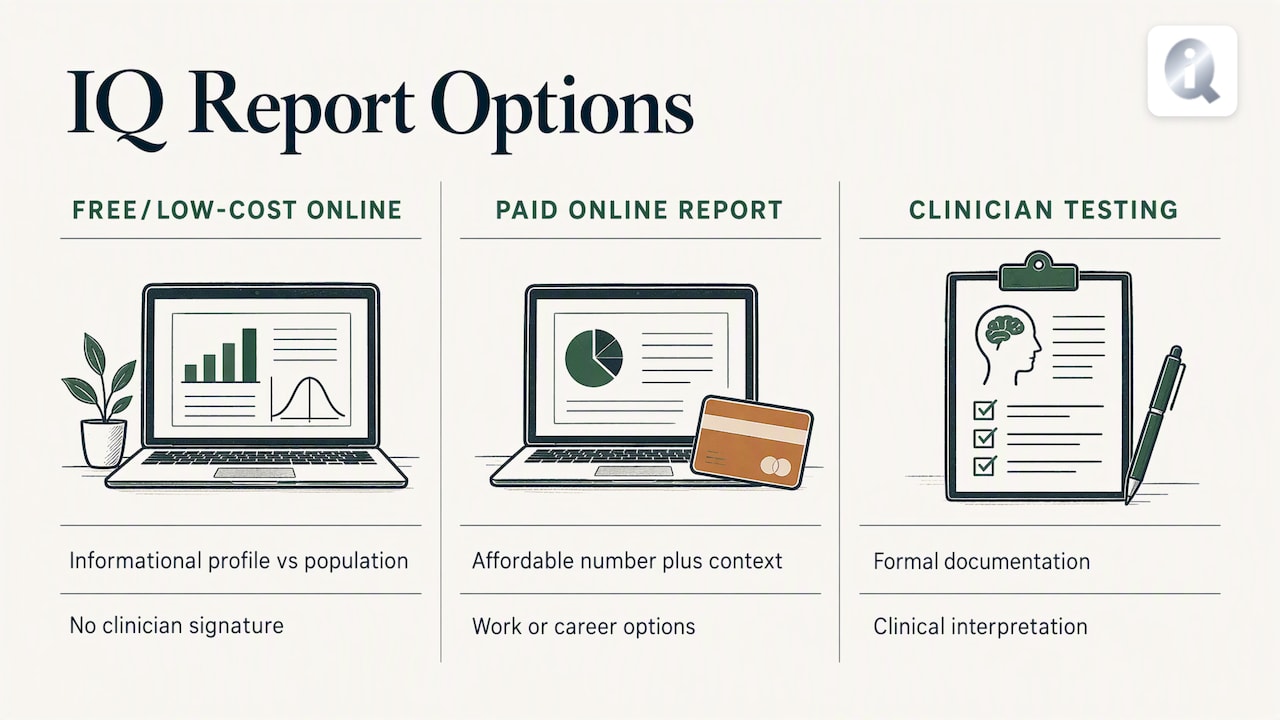
Readers often assume a higher price always buys a “better” test, but the instrument itself is rarely the deciding factor. The real split is between a number and a decision. A free or low-cost online report can tell you, with reasonable accuracy for informational purposes, where your cognitive profile sits relative to a population. What it cannot do is stand in for a clinician’s signature when a school, employer, or legal process requires one.
Our own view is that most people shopping for “IQ test cost” are not actually shopping for a diagnosis. They want a credible, affordable number and some context for what it means for their work or career options. For that use case, a paid online report is the economical, evidence-aware choice, and clinician testing should be reserved for situations that genuinely require formal documentation or clinical interpretation.
— Steve
How our paid online report compares on value
For readers who want more than a free score but do not need a clinical evaluation, we built our Full IQ Result around exactly that middle ground. It unlocks for a one-time $9.99 payment, at a one-time price below that of many paid online assessments, and includes your exact score, percentile standing, and a breakdown across cognitive domains rather than a single composite number.
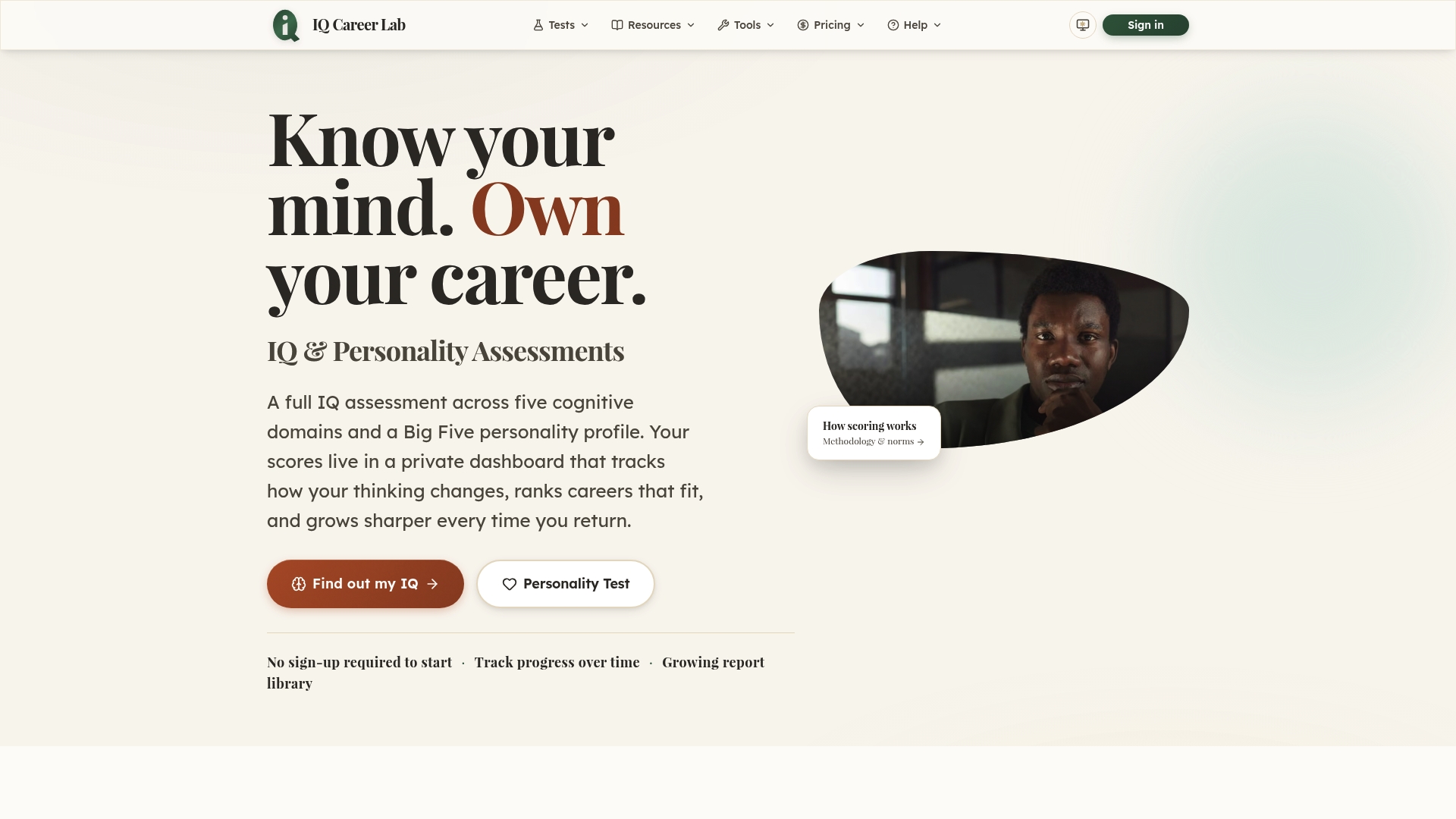
- Exact score and percentile replace the vague range you get from free screenings.
- A cognitive domain breakdown shows relative strengths rather than one undifferentiated figure.
- A verifiable certificate gives you something shareable for personal or career use.
- Career-matching tools connect your profile to live job listings based on cognitive strengths.
This fits job seekers, students, and professionals who want a credible number for personal insight or career planning, not a document for diagnosis or legal use. Start with the Full IQ Assessment or review full pricing on our pricing page to unlock your complete report today.
FAQ
How much does an IQ test typically cost?
Prices range from free for automated online screenings to varying fees for paid online reports. Organized admission testing costs about $60 for local group testing and about $99 for private testing, while clinician-administered evaluations have varying fees. The main driver of cost is whether the fee includes a scored report, written interpretation, and a feedback session, not the test name alone.
Is an IQ test worth it?
It depends on your purpose. A low-cost or free online test is generally worth it for curiosity or career planning, while a clinician-administered evaluation is worth its higher price when the result needs to support a diagnosis, accommodation, or legal or employment decision, per APA guidance on matching assessment to appropriate use.
Is a 120 IQ considered high?
An above-average score on a standard IQ scale is higher than the population average. It is a solid, meaningfully above-average result, though it is not in the range typically associated with gifted classification.
Is a 97 IQ considered low?
A score near the population midpoint generally falls within the average range on standard IQ scales. It is close to the population midpoint and is not considered low by standard test interpretation.
What is Elon Musk’s IQ?
There is no verified, publicly documented IQ score for Elon Musk from a standardized clinical assessment. Any specific number circulating online is unverified and should not be treated as a factual test result.
Sources
- Take the Mensa Admission Test
- APA PsycNET
- Principles for the Validation and Use of Personnel Selection Procedures | Fifth Edition