Big Five Traits: The Five Dimensions of Personality Explained

The Big Five traits are openness, conscientiousness, extraversion, agreeableness and neuroticism. Together they form the most widely used scientific framework for describing personality, also called the five-factor model. Each trait is a continuum, not a category: you receive a position between low and high on all five, and most people land somewhere in the middle. This guide defines each dimension, shows what high and low scores look like in daily life, explains how scores are interpreted, and addresses how stable the traits are.
TL;DR
- The Big Five (OCEAN) are openness, conscientiousness, extraversion, agreeableness and neuroticism. The model is also called the five-factor model.
- Every trait is a spectrum. A “low” score is not a flaw, and a “high” score is not an achievement; each describes a tendency.
- Scores are meaningful mainly in comparison with a large reference sample, which is how a percentile is produced.
- Neuroticism describes emotional reactivity to stress. It is a trait, not a diagnosis.
- Traits are fairly consistent across short periods in adulthood, yet they can shift across a lifetime.
Table of Contents
- What the Big Five model means
- The five Big Five dimensions at a glance
- Openness to experience
- Conscientiousness
- Extraversion
- Agreeableness
- Neuroticism
- How to read your Big Five scores
- How stable are Big Five traits?
- Big Five traits at work and in career exploration
- Big Five compared with other personality frameworks
- Our perspective
- Take the Big Five assessment
- FAQ
- Sources
What the Big Five model means
The Big Five, also known as the five-factor model, is a psychological framework built on research dating back to the 1970s that organizes personality into five core areas. The model did not start from a theory about what personality should contain. Researchers analyzed English words used to describe personality and applied statistical techniques to find clusters of related characteristics. Those clusters condensed into a small number of broad dimensions, and five repeatedly emerged.
This origin explains the model’s appeal. The dimensions are empirical groupings of how people describe one another, which is why the framework is treated as a descriptive taxonomy rather than a set of personality “types.”
Why the acronym is OCEAN (or CANOE)
The five names are commonly remembered through the acronyms OCEAN or CANOE, both of which use the same letters in a different order:
- Openness to experience
- Conscientiousness
- Extraversion
- Agreeableness
- Neuroticism
You will see “extroversion” and “extraversion” used interchangeably. Psychologists generally write the second form; both refer to the same dimension.
The five Big Five dimensions at a glance
The table below summarizes what each dimension describes, based on the Cleveland Clinic’s description of the five areas.
| Trait | Core question it answers | Higher scores tend to look like | Lower scores tend to look like |
|---|---|---|---|
| Openness | How do you respond to new situations and ideas? | Creative, adventurous, curious | Preference for routine and tradition |
| Conscientiousness | How thoughtful and thorough are you? | Enjoys checklists, plans, milestones | More likely to procrastinate |
| Extraversion | Where do you get your energy and what fulfills you? | Enjoys social activity | Prefers quieter, more solitary settings |
| Agreeableness | How do you care for others versus yourself? | Values harmony, cooperative | More direct, more competitive |
| Neuroticism | How do you react to stress, anxiety and difficult feelings? | Reacts strongly to stress and worry | Calmer, more emotionally even under pressure |
The higher and lower descriptions for openness, conscientiousness, extraversion, agreeableness and neuroticism follow the everyday examples in that source. The contrasts for extraversion, agreeableness and neuroticism on the low side are the natural opposite ends of each spectrum.
Openness to experience
Openness captures how a person responds to new situations, ideas and experiences. Someone high in openness may be creative and adventurous. Someone low may prefer routine and tradition, and be more comfortable with what is familiar.
Two cautions help here. First, low openness is not a lack of intelligence or imagination; it reflects a preference for the proven and concrete. Second, the link between openness and creative output is more nuanced than the stereotype suggests. Our review of openness and creativity research covers what the evidence does and does not show.
Conscientiousness
Conscientiousness describes how thoughtful and thorough a person is. A highly conscientious person may enjoy checklists and milestones, keeping track of commitments and finishing what they start. Someone lower may procrastinate, work more spontaneously, and tolerate disorder more easily.
In a work context, the trait tends to show up as reliability, planning and follow-through. Lower scores often pair with flexibility and comfort improvising, which suits some roles better than rigid process does.
Extraversion
Extraversion concerns where you get your energy and what you find fulfilling. An extravert may enjoy social activity and gain energy from it. A person lower on the trait, often called an introvert in everyday speech, may prefer smaller groups or time alone to recover.
The everyday labels hide the fact that this is a spectrum. Many people sit near the middle, enjoying company in some settings and solitude in others. In a scored assessment, that middle position is common and is not an indecisive result.
Agreeableness
Agreeableness is about how you weigh the care of others against your own interests. A highly agreeable person may value harmony and cooperation. The description used in one personality documentation resource is easygoingness and prosociality, meaning a desire to help others and fit in.
Lower agreeableness is not hostility. It often appears as bluntness, skepticism and willingness to compete or to challenge a group, qualities that matter in negotiation, auditing and critical review.
Neuroticism
Neuroticism describes how a person responds to feelings, stress and anxiety. Someone high in neuroticism may react strongly to stress and worry, while someone low tends to stay steadier.
Is neuroticism a mental health diagnosis?
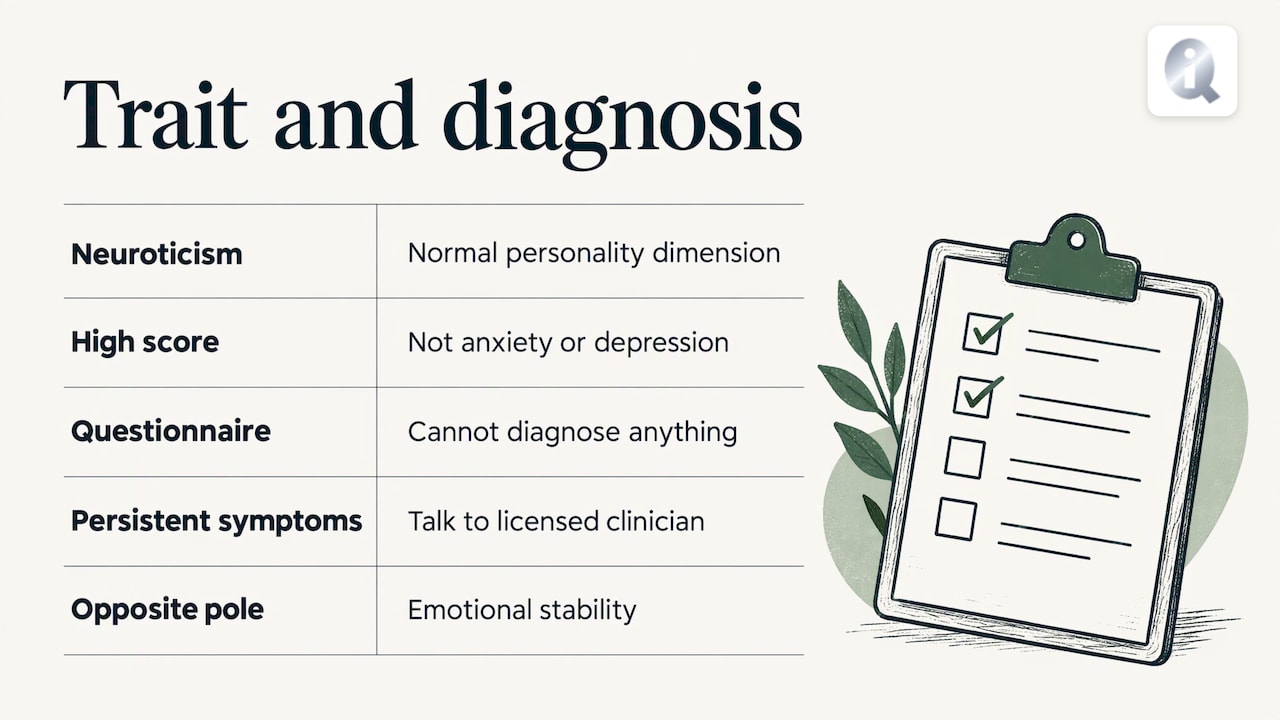
No. In the Big Five, neuroticism is a dimension of normal personality that everyone has to some degree. A high score does not mean a person has an anxiety disorder or depression. Research does connect the trait with later symptoms: neuroticism may be linked to the emergence of symptoms and psychopathology, yet the same literature notes that many people with high scores never develop a disorder. A personality questionnaire cannot diagnose anything. If persistent anxiety, low mood or worry is affecting your daily life, a licensed clinician such as a psychologist, psychiatrist or primary care physician is the right person to talk to.
The word itself causes confusion. In the Big Five it is a neutral technical label for emotional reactivity. Some assessments rename the opposite pole “emotional stability” for this reason.
How to read your Big Five scores
A Big Five questionnaire shows how low or high a person rates on each trait. Many online tests then compare your answers with a large sample, which gives a picture of how you rate relative to others. That comparison is usually reported as a percentile. A 70th percentile in conscientiousness means you scored higher than about 70 percent of the reference group on that trait.
A few principles keep interpretation sound:
- Read each trait separately. The five scores are independent dimensions. Combining them into a single label loses information.
- Think in ranges. People do not fall into neat categories; most sit between the extremes, so scores near the 40th to 60th percentile mean “typical,” not “undefined.”
- Check the reference sample. Percentiles depend on who the comparison group was. A larger and more representative group gives a more informative figure.
- Treat the result as self-report. The scores reflect how you rated yourself on a given day, which is useful but subject to mood and self-perception.
- Remember what is not measured. Personality traits are not the whole picture. Emotional intelligence also shapes motivation, resilience, impulse control and mood regulation.
Example: reading a five-trait profile
Imagine a profile with high openness, high conscientiousness, middling extraversion, middling agreeableness and low neuroticism. Read trait by trait, it describes someone who likes new ideas, plans carefully, adapts to social settings and stays level under pressure. Nothing in that sentence predicts a job title or a life outcome; it describes tendencies that interact with circumstances.
How stable are Big Five traits?
Big Five measures tend to be fairly consistent over short periods in adulthood but change across a lifetime, and deliberate personality change may also be possible. In practice, this means a retest a few weeks apart should look similar, while a comparison between age 20 and age 50 may show real differences.
The practical consequence is that a result is a snapshot with some durability, not a verdict. If you take an assessment during an unusually stressful period, particularly for neuroticism, it is reasonable to retake it later and compare.
Big Five traits at work and in career exploration
Personality traits are often used to explore work style: how you prefer to plan, collaborate, handle pressure and take on novelty. The relationship between personality and career fit is a matter of tendencies, not rules, and no trait profile excludes a person from a field.
A reasonable way to use your results is as one input among several:
- Conscientiousness and openness can inform whether you prefer structured processes or open-ended problem solving.
- Extraversion and agreeableness can inform how much collaboration, client contact or negotiation you want in a day.
- Neuroticism can inform how you manage deadlines, ambiguity and feedback, and which supports help you do so.
When you translate a profile into a professional presentation, evidence of your actual work matters as much as self-description. One practical guide on authentic positioning with AI career tools discusses how to present verified achievements honestly, which pairs well with any trait-based self-assessment.
To see how your cognitive profile and interests intersect with real occupations, our Career-IQ Matcher is a free starting point.
Big Five compared with other personality frameworks
The Big Five is often contrasted with type-based tools. The key distinction is structural: type tools sort people into categories, while the Big Five places each person on five continuous scales. We compared how well each approach predicts outcomes in our analysis of Big Five versus MBTI predictive accuracy.
There are also alternatives within trait science. The HEXACO model adds a sixth dimension, honesty-humility. Our article on Big Five versus HEXACO examines which model better predicts morality and wellbeing.
Our perspective
We built the personality side of IQ Career Lab on the Big Five because it is the framework with the clearest statistical foundation: five continuous dimensions, reported as percentiles, with no forced labels.
Our position is that a personality result is most useful when it is specific and comparable. A percentile for each of the five domains tells you more than a single type name, and a facet-level profile tells you more again, because “conscientiousness” bundles together habits that can differ from one another within one person.
That is why our Big Five assessment is free after sign-in, with OCEAN trait percentiles and a personality archetype included. For readers who want depth, Personality Full Access adds a detailed personality profile, workplace-fit insights and a verifiable certificate, for a one-time payment per result. It is not a subscription.
We also encourage readers to pair personality with cognitive strengths, since career interests are shaped by both. A trait profile describes how you tend to work; an IQ domain breakdown describes what kinds of problems you tend to solve quickly. Together they give a more complete basis for exploring careers.
Steve
Take the Big Five assessment
If you want your own scores rather than definitions, our Big Five personality assessment requires sign-in and gives you OCEAN trait percentiles and a personality archetype at no cost.
For more depth, Personality Full Access costs $14.99, paid once per result. It adds a detailed personality profile, workplace-fit insights and a verifiable certificate. You can see what the report contains on the personality profile page. If you also want your cognitive result, the Full IQ Result is $9.99, once per completed result, also not a subscription.
FAQ
What are the Big Five traits?
The Big Five traits are openness, conscientiousness, extraversion, agreeableness and neuroticism. They are the five broad dimensions of the five-factor model of personality. Each is measured on a spectrum from low to high rather than as an either/or category.
What does the Big Five mean in simple terms?
It means personality can be described by where you fall on five independent scales. The scales came from statistical analysis of the words people use to describe personality. The result is a profile of tendencies, not a type or a diagnosis.
Can my Big Five traits change?
Yes, gradually. Scores tend to stay fairly consistent over short periods in adulthood, yet they can change over a lifetime, and deliberate change may be possible. A retest after a significant life change can show whether your profile has moved.
Is a high neuroticism score bad?
No. It describes a tendency to react more strongly to stress and anxiety, and it is not a diagnosis. If worry or low mood is interfering with your life, a licensed mental health professional can assess it properly, which a personality questionnaire cannot do.
Which Big Five trait matters most?
None is universally the most important. Each trait matters in different settings, and the combination of all five is more informative than any single score.
Sources
- What Are the Big 5 Personality Traits? (Cleveland Clinic)
- Big 5 Personality Traits (Psychology Today)
- Using the Big Five Personality Traits (OCEAN) in Practice (PositivePsychology.com)
- Contextualizing Neuroticism in the Hierarchical Taxonomy of Psychopathology (Frontiers in Psychiatry, via PubMed Central)